









A Defunct Newspaper or magazine can present significant challenges for publishers who wish to continue their publication activities. This status may arise due to incomplete Annual Statements, interruptions in publication, outstanding penalties, non-compliance with PRGI requirements, or inadequate maintenance of publication records.
Following the transition from the former RNI system to the Press Registrar General of India (PRGI) framework, publishers need to understand the current registration status of their publications before proceeding with any corrective action. Various publisher services and compliance-related activities are now handled through the Press Sewa Portal.
There is no single solution that applies to every Defunct Newspaper case. The appropriate course of action depends on the publication’s existing official status, the reasons behind its classification, and the compliance requirements that remain outstanding.
Therefore, publishers should begin by examining their official records, identifying the underlying issues, and determining the applicable PRGI procedure before submitting any application.
Index
- What Is a Defunct Newspaper or Magazine?
- Major Reasons for Defunct Status
- Solution for Defunct Newspaper
- Publication Continuity Certificate – PCC
- Annual Return/Annual Statement Submission
- Penalty Payment
- Importance of Professional Advice
- Why New Sense Marketing Services Pvt Ltd?
- Defunct vs Cancelled Status
- Compliance Checklist
- Frequently Asked Questions
- Conclusion and Contact Details
What Is a Defunct Newspaper or Magazine?
A Defunct Newspaper or magazine refers to a registered periodical that appears under a defunct classification in the relevant official records because of publication-related interruptions or regulatory compliance concerns.
It is important for publishers to understand that defunct, suspended, and cancelled statuses are not necessarily interchangeable. Each status may have different implications, and the available course of action depends on the actual classification recorded by PRGI.
The first and most important step is to verify the publication’s current official status.
Before initiating any corrective procedure, publishers should carefully examine the following information:
- Newspaper or magazine title
- Registration number
- Language of publication
- Registered periodicity
- Owner and publisher information
- Present PRGI registration status
A proper examination of these details helps establish the actual position of the publication and determine the next appropriate step.
Major Reasons for Defunct Newspaper or Magazine Status
A publication may face defunct classification or related compliance difficulties for several reasons. Understanding the underlying cause is essential before deciding how to proceed.
| No. | Reason | Possible Issue |
| 1 | Failure to follow PRGI guidelines and advisories | Regulatory or compliance action |
| 2 | Non-submission of Annual Return/Annual Statement | Pending compliance and possible penalties |
| 3 | Outstanding penalty | Unresolved financial compliance |
| 4 | Failure to upload or submit publication copies | Difficulty demonstrating publication regularity |
| 5 | Extended interruption in publication | Questions regarding publication continuity |
| 6 | Missing or incomplete documents | Delays or deficiencies in compliance |
| 7 | Failure to respond to PRGI communications | Possibility of further regulatory action |
The actual consequences depend on the individual publication’s registration history and the applicable PRGI rules, notices, and advisories.
1. Non-Compliance with PRGI Guidelines and Advisories
The Press Registrar General of India periodically issues instructions, notices, and advisories to publishers regarding different registration and compliance matters.
These communications may cover Annual Statements, outstanding penalties, publication continuity, defunct titles, cancelled registrations, and other regulatory requirements.
Ignoring an applicable PRGI communication or failing to complete the required action can create additional difficulties for publishers.
In the case of a Defunct Newspaper, it is important to examine previous communications and identify all outstanding requirements before proceeding with a resolution.
The review should cover:
- Existing registration status
- Previous RNI/PRGI registration records
- History of Annual Statement submissions
- Outstanding penalty information
- Available publication records
- Previous PRGI notices and advisories
- Ownership and publisher details
Reviewing these records provides a clearer understanding of the problem and helps identify the appropriate compliance procedure.
2. Non-Submission of Annual Return of Newspaper or Magazine
Failure to submit the Annual Return, commonly referred to as the Annual Statement under the PRGI framework, is one of the important compliance concerns for registered newspapers and magazines.
Publishers must submit their Annual Statements in accordance with the applicable PRGI requirements and prescribed timelines. Missing the required filing may attract penalties and, depending on the circumstances, additional regulatory consequences.
In older Defunct Newspaper cases, publishers may discover that Annual Statements for multiple previous years are still outstanding.
Before proceeding, the following points should be examined:
- Identify the financial or reporting years for which statements remain pending.
- Verify whether any penalties have been imposed.
- Check whether the relevant filing facility is available on the portal.
- Determine whether additional supporting documents are necessary.
- Review whether any specific PRGI advisory applies to the publication.
When historical records are incomplete, a detailed professional assessment can help organize the available information and identify the remaining requirements.
3. Penalty Due
Outstanding penalties are another issue that publishers may encounter while resolving newspaper or magazine registration compliance matters.
If a penalty has been imposed due to delayed or missing Annual Statement submissions, the publisher may be required to complete the applicable payment procedure.
However, paying the penalty does not necessarily mean that the entire Defunct Newspaper matter has been resolved.
Depending on the publication’s circumstances, additional requirements may include:
- Submission of pending Annual Statements
- Providing relevant supporting documents
- Establishing publication continuity
- Responding to specific PRGI notices or communications
Publishers should first identify the complete list of outstanding compliance requirements rather than making a payment without reviewing the overall registration position.
4. Non-Uploading or Non-Submission of Daily, Weekly or Monthly Publication
Maintaining proper publication records is an important responsibility for newspaper and magazine publishers.
Depending on the applicable requirements, publishers may need to preserve or submit copies of their published issues to demonstrate that the publication has maintained its declared periodicity.
| Periodicity | Records to Maintain |
| Daily | Copies of daily editions |
| Weekly | Copies of weekly editions |
| Fortnightly | Copies of fortnightly issues |
| Monthly | Copies of monthly magazines |
| Quarterly | Records of quarterly publications |
For an older Defunct Newspaper, historical publication copies can become particularly valuable when the publisher needs to establish the continuity of publication.
Publishers should maintain their available printed editions and digital publication records in an organized manner so that authentic evidence can be produced whenever required.
Solution for Defunct Newspaper or Magazine
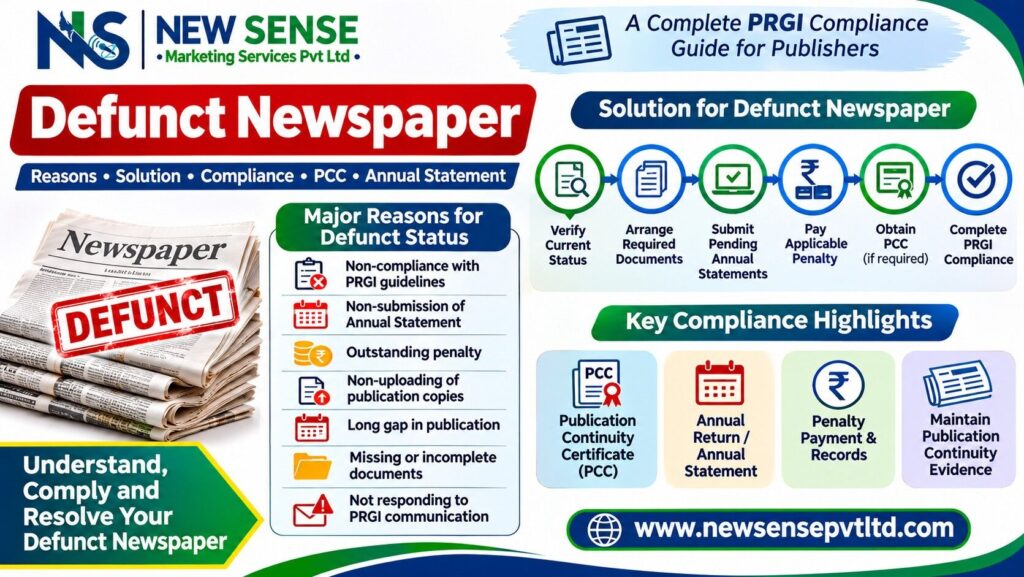
Resolving a Defunct Newspaper does not follow an identical procedure in every case. The appropriate solution depends on the current PRGI registration status, the reason for the defunct classification, and the publication’s previous compliance history.
Depending on the individual circumstances, the resolution process may involve:
- Publication Continuity Certificate (PCC)
- Submission of pending Annual Returns/Annual Statements
- Payment of applicable penalties
- Preparation and submission of supporting documents
- Compliance with relevant PRGI notices and advisories
- Providing authentic publication records and continuity evidence
- Professional assistance with procedural follow-up
Not every publication will require all these steps. Publishers should first establish which requirements apply to their particular registration before starting the process.
Publication Continuity Certificate – PCC
The Publication Continuity Certificate (PCC) may play an important role in certain cases involving defunct publications.
It is intended to provide evidence of publication continuity wherever the applicable PRGI procedure requires such documentation.
For a Defunct Newspaper, the publisher may need to arrange historical publication records to support the continuity of the publication.
Relevant supporting records may include:
- Previously published newspaper editions
- Magazine issues
- Publication dates
- Declared periodicity
- Registration particulars
- Publisher information
- Other relevant supporting documents
The PCC-related procedure should be followed according to the applicable official requirements.
Publishers must ensure that all submitted records are genuine and accurate. Creating, modifying, or presenting false publication evidence can create serious compliance problems.
Annual Return Submission
Annual Statement filing should be considered a continuing responsibility for every registered newspaper and magazine publisher rather than an activity that needs attention only when a compliance problem arises.
For an older Defunct Newspaper, it is advisable to examine Annual Statement compliance separately for each relevant year.
Recommended Review
Step 1: Prepare a list of all years for which Annual Statements have not been submitted.
Step 2: Verify whether any penalties are applicable or have already been imposed.
Step 3: Collect and organize the available circulation and publication records.
Step 4: Complete the relevant online submission process wherever filing is permitted.
Step 5: Preserve all submission acknowledgements and payment receipts for future reference.
Following a year-wise compliance approach helps publishers maintain better records and manage subsequent PRGI requirements more efficiently.
Penalty Payment and Compliance
When an outstanding penalty is identified, the publisher should first confirm the applicable amount and prescribed payment procedure through the authorized PRGI system.
Once payment has been completed, the transaction receipt should be retained safely as part of the publication’s compliance documentation.
For better record management, the complete compliance file should ideally include:
- Annual Statement submission acknowledgements
- Penalty payment receipts
- Newspaper or magazine publication copies
- Publication Continuity Certificate (PCC), wherever applicable
- PRGI notices and correspondence
- Registration certificates and related documents
- Ownership-related records
Maintaining these documents together makes it easier to review the publication’s registration history and respond to future compliance requirements.
Why Professional Advice Is Important
Resolving a Defunct Newspaper or magazine can involve several connected regulatory and documentation issues. Addressing only one problem may not be sufficient if other compliance requirements remain incomplete.
For example, a publication may require attention to multiple connected matters:
Defunct Status → Pending Annual Statements → Outstanding Penalty → Publication Continuity → Supporting Documents → PRGI Compliance
If any applicable requirement is overlooked, the overall matter may continue to remain unresolved.
Professional guidance can help publishers examine their existing registration records, identify documentation gaps, understand pending obligations, and arrange the necessary compliance submissions.
Professional assistance can be especially valuable in situations involving:
- Old RNI/PRGI registrations
- Multiple pending Annual Statements
- Penalty-related matters
- Defunct newspaper and magazine registrations
- Publication continuity requirements
- Ownership transfer procedures
- PRGI objections
- Registration-related documentation
Experienced consultation can help organize the process and reduce avoidable documentation mistakes. However, professional assistance cannot guarantee approval, as the final decision rests with the competent authority.
Why New Sense Marketing Services Pvt Ltd Can Be Beneficial
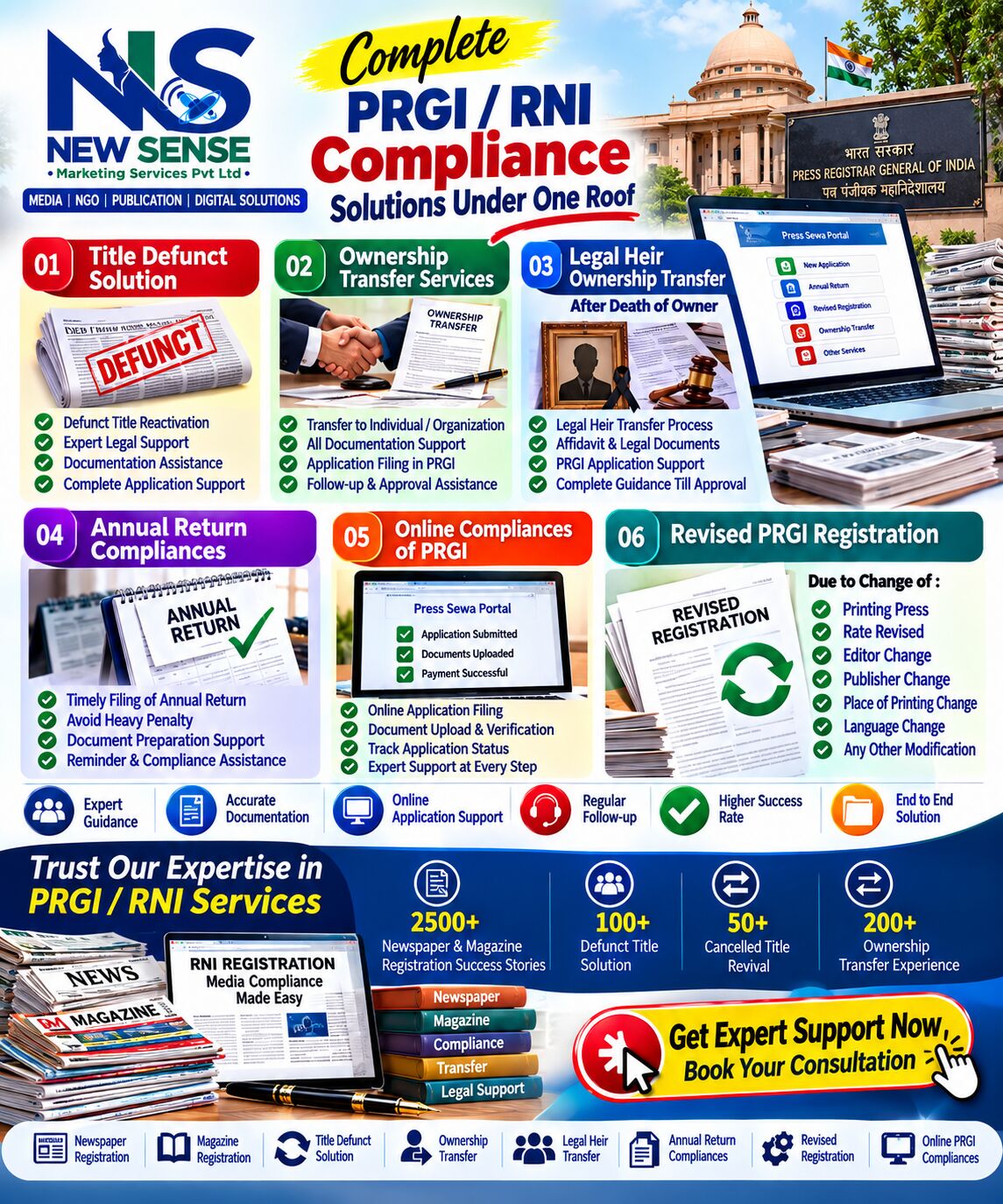
New Sense Marketing Services Pvt Ltd provides consulting assistance for newspaper, magazine, and media-related registration and compliance requirements.
The company states that it has experience working with more than 2500+ RNI/PRGI newspaper and magazine clients, including matters relating to defunct publications and ownership transfers.
Its consulting services include:
- RNI/PRGI Registration Consulting
- Defunct Newspaper Solution
- Defunct Magazine Solution
- Newspaper and Magazine Ownership Transfer
- Annual Compliance Assistance
- PRGI Objection Reply Assistance
- Registration Rejection Review
- Newspaper and Magazine Consulting
- Media Consulting Services
Prospective clients can also independently examine the company’s Google Business Profile reviews and Facebook presence to learn more about its services and client feedback.
Before selecting any consultant, publishers should consider professional experience, service conditions, documentation requirements, and the clarity of communication.
New Sense Marketing Services Pvt Ltd
Contact: 9411229553
Email: consulting@newsensepvtltd.com
Website: https://newsensepvtltd.com
Defunct Newspaper vs Cancelled Newspaper
Understanding the difference between a defunct newspaper and a cancelled newspaper registration is important before deciding on the next course of action.
These classifications should not automatically be treated as identical because their regulatory implications and available procedures may differ.
| Defunct Newspaper | Cancelled Newspaper |
| The publication appears under a defunct classification. | The newspaper registration has been cancelled. |
| A compliance review may be possible, depending on the case. | Fresh registration may become relevant depending on the official status. |
| PCC may be applicable in certain cases. | Revival may not be permitted in every situation. |
| Pending Annual Statements may need to be reviewed. | Earlier compliance records may still require examination. |
PRGI has issued advisories concerning cancelled titles in which revival was not to be entertained under certain circumstances.
For this reason, publishers should verify the exact registration status before assuming that a cancelled newspaper can be restored through a routine compliance process.
Compliance Checklist
Before proceeding with a Defunct Newspaper resolution, publishers should review the following records and requirements:
- Verify the current PRGI registration status.
- Confirm the newspaper or magazine registration details.
- Examine previous RNI/PRGI records.
- Identify pending Annual Statements.
- Check applicable penalty details.
- Collect available newspaper or magazine copies.
- Review publication continuity requirements.
- Check whether PCC is applicable.
- Arrange ownership and publisher documents.
- Review previous PRGI notices and advisories.
- Identify the applicable online filing procedure.
- Preserve all acknowledgements and payment receipts.
The checklist provides a starting point for reviewing the publication’s compliance position. The actual documents and actions required will depend on the individual case.
Frequently Asked Questions
1. What is a Defunct Newspaper?
A Defunct Newspaper is a registered newspaper that appears under a defunct classification in the relevant official records due to publication interruptions or compliance-related issues.
2. Can a Defunct Newspaper be restored?
The possibility depends on the current PRGI registration status, the applicable procedure, and the publication’s historical compliance records.
3. Is PCC required in every defunct case?
No. Whether a Publication Continuity Certificate is required depends on the applicable procedure and the circumstances of the individual publication.
4. What does PCC mean?
PCC stands for Publication Continuity Certificate.
5. What is an Annual Statement?
An Annual Statement is the yearly compliance statement that registered periodicals are required to submit under the applicable PRGI framework.
6. Can pending Annual Statements create problems?
Yes. Failure to submit the required Annual Statements may lead to penalties and other regulatory consequences, depending on the circumstances.
7. Can penalty payment alone resolve a Defunct Newspaper issue?
Not necessarily. The publisher may also need to complete pending Annual Statements, provide supporting records, establish publication continuity, or fulfil other applicable requirements.
8. Can a magazine also become defunct?
Yes. Compliance-related issues can affect magazines and other registered periodicals in addition to newspapers.
9. Which records can help establish publication continuity?
Authentic published editions, publication dates, periodicity details, and other relevant publication records may help demonstrate continuity.
10. Can a cancelled newspaper always be revived?
No. The possibility depends on the actual PRGI status and the procedure applicable to the cancelled registration.
11. What is the Press Sewa Portal?
The Press Sewa Portal is the online platform through which publishers access various PRGI registration services and compliance-related facilities.
12. Can Annual Statements be submitted online?
Yes. Applicable Annual Statement submission services are available through the Press Sewa Portal.
13. Is ownership transfer possible for a Defunct Newspaper?
It depends on the publication’s current registration status and the applicable PRGI procedure.
14. Why should publishers consult a professional?
A professional consultant can assist with reviewing registration records, identifying pending compliance requirements, organizing supporting documents, and preparing relevant submissions.
15. Does professional consultation guarantee PRGI approval?
No. Consultation can help with documentation and procedural requirements, but the final decision remains with the competent authority.
16. Can New Sense Marketing Services Pvt Ltd assist with defunct publications?
Yes. The company offers consulting services related to newspaper and magazine registration, compliance matters, defunct publications, and ownership transfers.
17. How can I contact New Sense Marketing Services Pvt Ltd?
You can contact the company through the following details:
- Mobile: 9411229553
- Email: consulting@newsensepvtltd.com
- Website: https://newsensepvtltd.com
Conclusion
A Defunct Newspaper or magazine requires careful examination of its registration history and outstanding compliance responsibilities. Issues such as pending Annual Statements, unpaid penalties, publication continuity, and PRGI notices may need to be addressed before determining the appropriate resolution.
Depending on the publication’s current official status, the necessary procedure may involve a Publication Continuity Certificate (PCC), Annual Statement submissions, penalty payments, and the preparation of supporting documents.
Publishers should begin by checking their official registration records and understanding the specific reason behind the defunct classification. It is equally important to follow the applicable current procedures rather than depending entirely on older processes, as PRGI requirements, advisories, and online services may change.
For publishers seeking professional guidance, New Sense Marketing Services Pvt Ltd provides consulting support for PRGI Registration of Newspaper, Defunct Newspaper and magazine matters, ownership transfers, and related compliance services. The company states that it has experience serving more than 2500+ RNI/PRGI newspaper and magazine clients.
Contact New Sense Marketing Services Pvt Ltd
- Website: https://newsensepvtltd.com/
- Contact / WhatsApp: 94112 29553
- Email : consulting@newsensepvtltd.com
- Our Magazine: https://prakritidarshan.com/
- Our Newspaper: https://prakritidarshannews.com/
- Our International Journal (ISSN): https://prakritidarshanjournal.com/index.php/pdijemds/index
Disclaimer
This article is intended for general informational and educational purposes only. It does not constitute official government notification or legal advice. The rules, fees, and portal procedures mentioned are based on the Press and Registration of Periodicals Act, 2023, and PRGI guidelines current as of 2026. Statutory fees and portal interfaces are subject to change by the Government of India. New Sense Marketing Services Pvt Ltd is an independent private consulting firm and is not affiliated with the PRGI or the Ministry of Information and Broadcasting. Final approval of any registration rests exclusively with the competent government authorities.