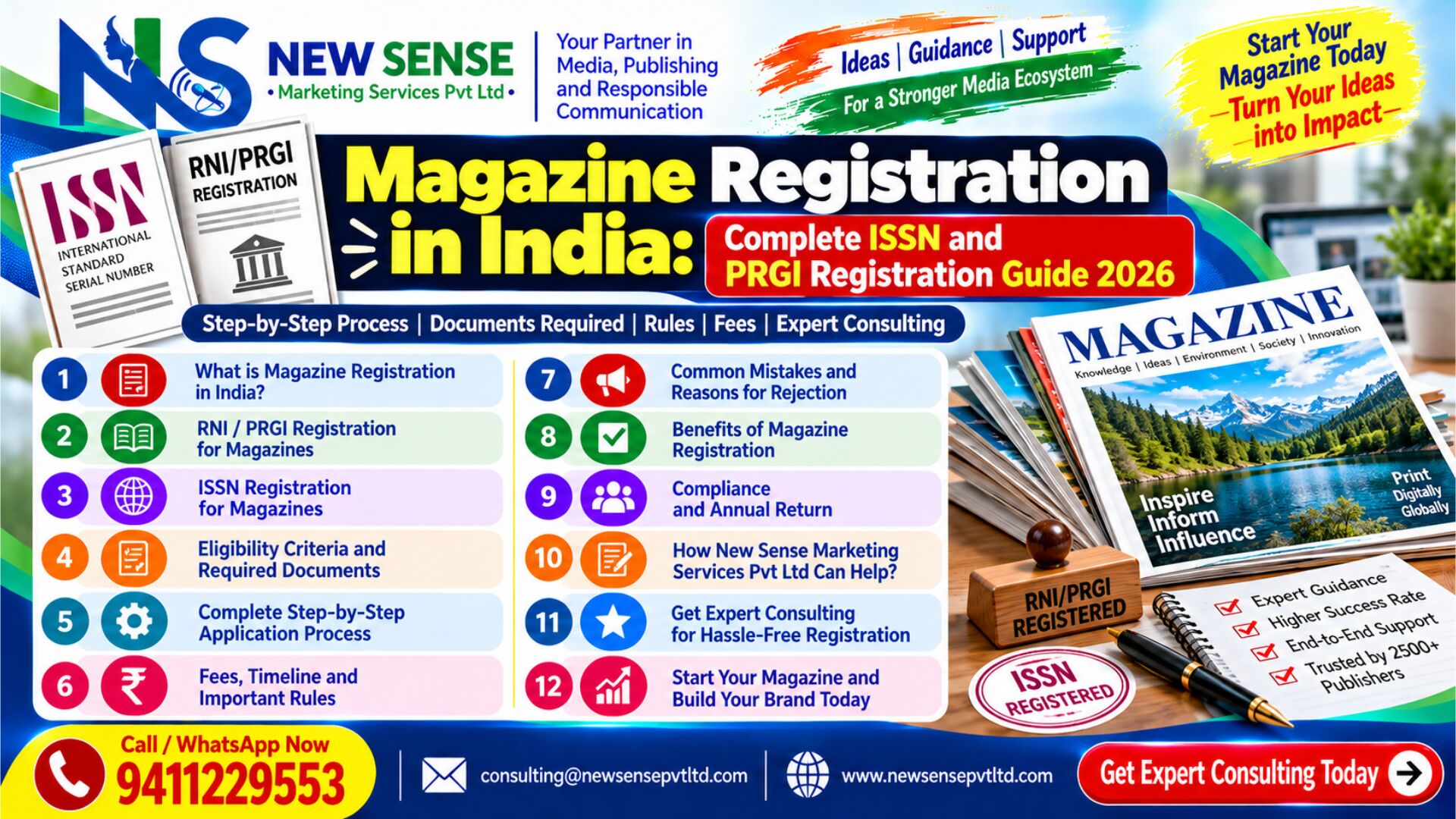

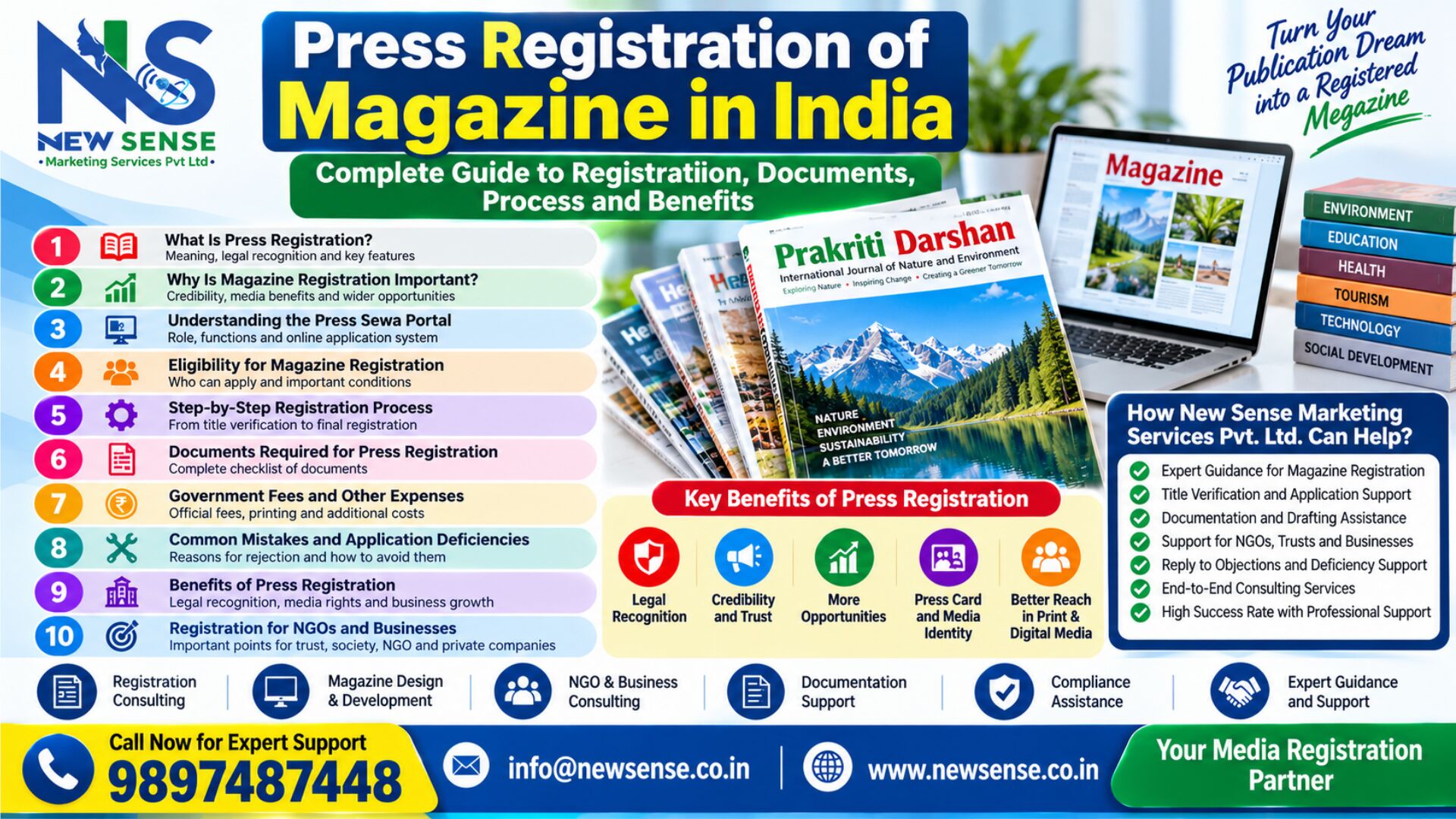




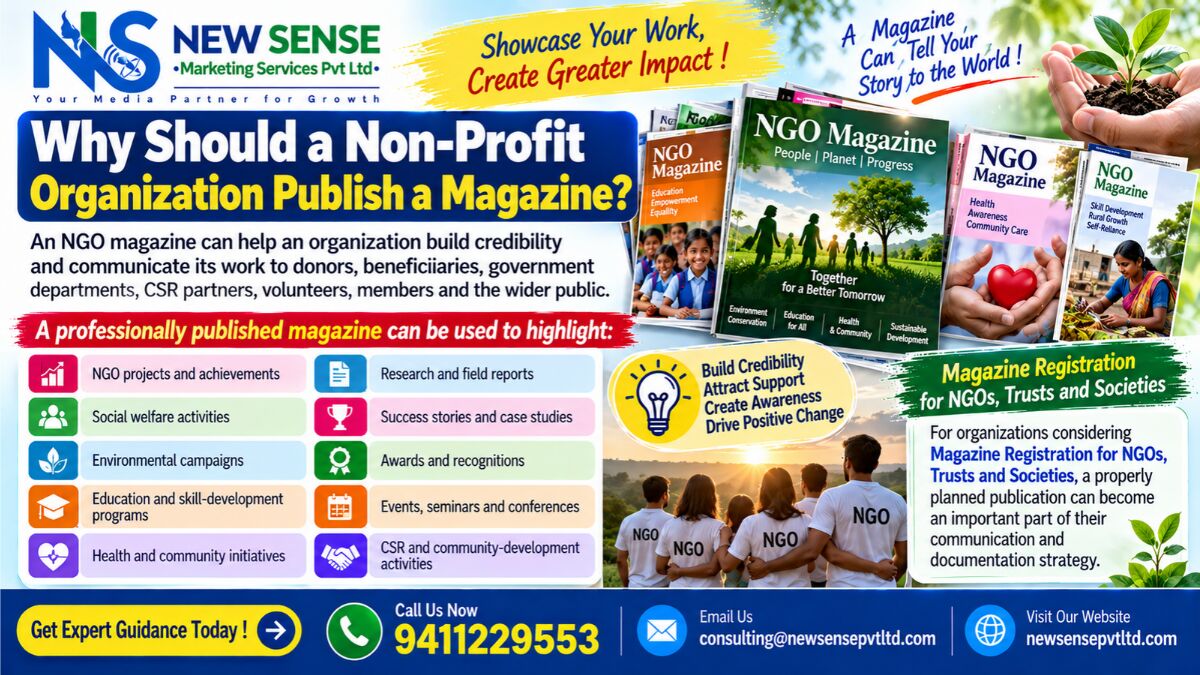


Magazine Registration in India is an important consideration for entrepreneurs, journalists, educational institutions, NGOs, charitable trusts, researchers, and businesses planning to launch a professional magazine. A magazine can share knowledge, promote social development, highlight tourism, publish interviews, build brand awareness, and create business opportunities through advertising and sponsorships.
Before starting a magazine, publishers should understand two important systems: ISSN registration and PRGI registration. These processes serve different purposes. ISSN provides an internationally standardized identifier for an eligible continuing publication, while PRGI registration applies to periodicals covered by India’s statutory registration framework.
The correct process depends on the magazine’s content, publication format, frequency, and legal classification. Some publications may qualify for ISSN without requiring PRGI registration, while eligible periodicals carrying public news or commentary must follow the applicable PRGI requirements. Both may be relevant where appropriate.
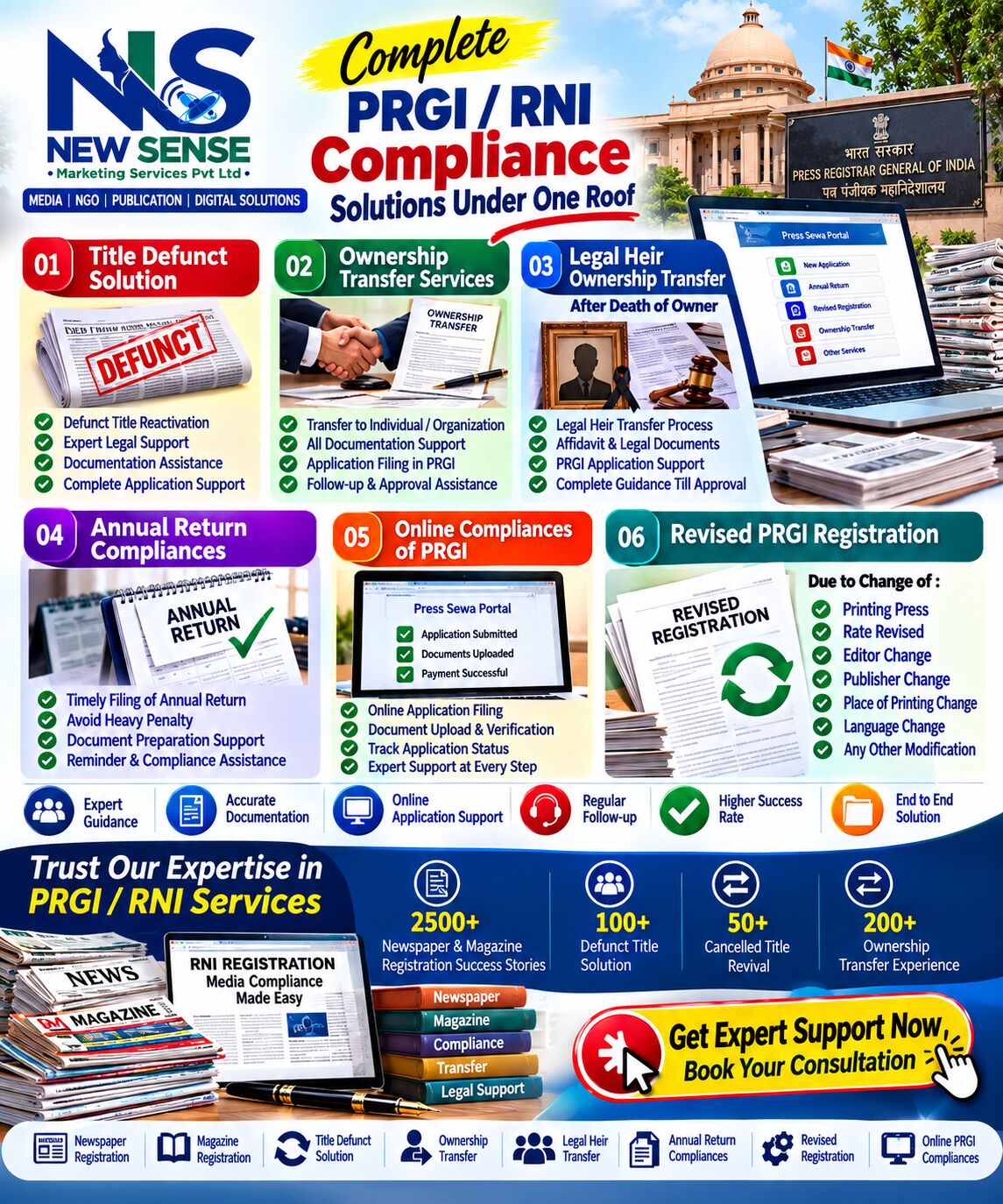
New Sense Marketing Services Pvt Ltd offers independent consulting support for magazine registration, publishing documentation, application preparation, and related publishing services.
This guide explains Magazine Registration in India, ISSN and PRGI guidelines, registration procedures, advertising opportunities, revenue models, and the benefits of professional consulting.
Table of Contents
- What Is Magazine Registration in India?
- Difference Between ISSN and PRGI Registration
- ISSN Registration Guidelines for Magazines
- PRGI Registration Guidelines for Magazines
- Can You Obtain Both ISSN and PRGI Registration?
- Documents Required for Magazine Registration
- Benefits of ISSN and PRGI Registration
- Magazine Publishing Revenue Models
- Government and Private Advertisements
- Magazine Promotion for NGOs and Charitable Organizations
- Tourism, Political Events, Development and Interviews
- Common Registration Mistakes
- Why Choose New Sense Marketing Services Pvt Ltd?
- Frequently Asked Questions
- Conclusion and Contact Details
1. What Is Magazine Registration in India?
Magazine Registration in India involves identifying and completing the applicable registration or publication-identification procedures for a magazine.
Magazines cover many subjects, including education, environment, business, tourism, healthcare, agriculture, literature, culture, research, and social development. Each publication must be assessed according to its actual nature and the relevant rules.
For example, an academic journal may follow a different route from a magazine publishing regular public news and commentary. Therefore, selecting the appropriate registration process is the first step toward establishing a compliant publishing business.
Before applying, decide:
- Magazine title: Select a distinctive and suitable name.
- Language: Decide whether the publication will be in English, Hindi, or another language.
- Frequency: Choose monthly, quarterly, or another realistic publishing schedule.
- Publication format: Decide whether it will be printed, digital, or available in separate editions.
- Subject: Define the editorial focus and intended readership.
- Ownership: Identify the individual, company, trust, society, or other eligible organization responsible for publication.
A clear publishing plan helps determine which registration requirements apply and what documents need to be prepared.
2. Difference Between ISSN and PRGI Registration
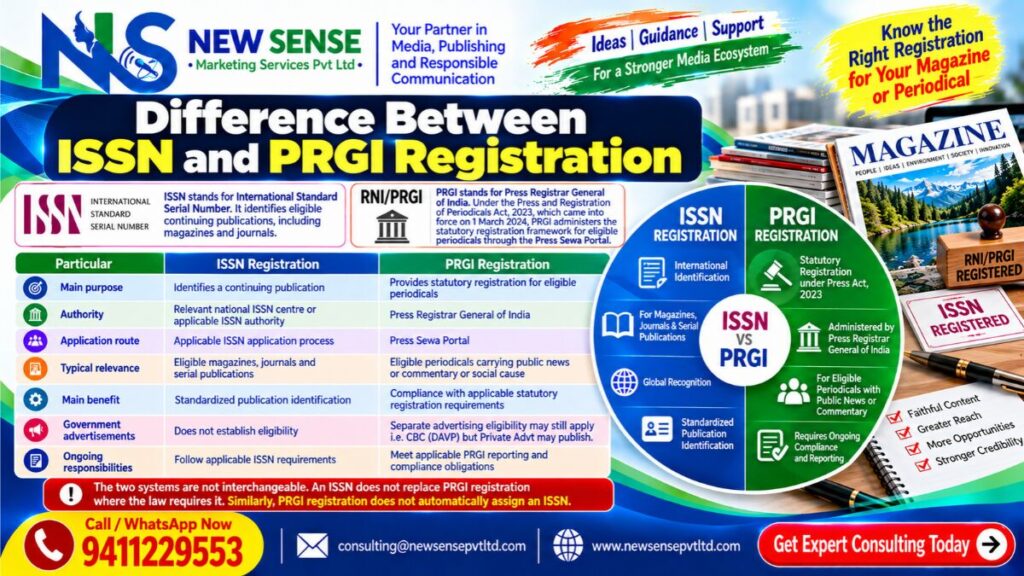
ISSN stands for International Standard Serial Number. It identifies eligible continuing publications, including magazines and journals.
PRGI stands for Press Registrar General of India. Under the Press and Registration of Periodicals Act, 2023, which came into force on 1 March 2024, PRGI administers the statutory registration framework for eligible periodicals through the Press Sewa Portal.
ISSN vs PRGI registration
| Particular | ISSN Registration | PRGI Registration |
| Main purpose | Identifies a continuing publication | Provides statutory registration for eligible periodicals |
| Authority | Relevant national ISSN centre or applicable ISSN authority | Press Registrar General of India |
| Application route | Applicable ISSN application process | Press Sewa Portal |
| Typical relevance | Eligible magazines, journals and serial publications | Eligible periodicals carrying public news or commentary or social cause |
| Main benefit | Standardized publication identification | Compliance with applicable statutory registration requirements |
| Government advertisements | Does not establish eligibility | Separate advertising eligibility may still apply i.e. CBC (DAVP ) but Private Advt may publish. |
| Ongoing responsibilities | Follow applicable ISSN requirements | Meet applicable PRGI reporting and compliance obligations |
The two systems are not interchangeable. An ISSN does not replace PRGI registration where the law requires it. Similarly, PRGI registration does not automatically assign an ISSN.
3. ISSN Registration Guidelines for Magazines
ISSN registration is useful for publishers seeking a standardized identifier for an eligible continuing magazine.
An ISSN contains eight characters, generally displayed as ISSN 1234-567X. It helps distinguish one continuing publication from another and supports bibliographic identification.
Who can apply for an ISSN?
Depending on eligibility and the applicable national ISSN centre’s requirements, the following publishers may consider applying:
- Educational institutions publishing magazines.
- Academic and research journal publishers.
- Environmental and nature magazines.
- Business and professional publications.
- Literary and cultural magazines.
- NGOs publishing continuing educational or development magazines.
- Eligible online magazine publishers.
How to apply for ISSN registration
Step 1: Finalize the magazine title. Establish a consistent title and define the publication’s subject.
Step 2: Prepare the publication. Organize editorial information, publisher details, and a representative issue or other evidence required by the relevant ISSN centre.
Step 3: Verify eligibility. Confirm that the publication qualifies as a continuing resource rather than a one-time book or report.
Step 4: Submit the application. Follow the applicable official application procedure and provide accurate information.
Step 5: Follow identification requirements. If an ISSN is assigned, display and use it correctly.
A print edition and an online edition may require separate ISSNs when they constitute distinct editions under ISSN rules.
An ISSN can support professional publication management, but it does not guarantee Google rankings, academic indexing, accreditation, government advertising, or commercial success.
4. PRGI Registration Guidelines for Magazines
PRGI registration is relevant to publications that fall within the definition of a periodical under the Press and Registration of Periodicals Act, 2023.
The Act covers publications issued at regular intervals containing public news or commentary on public news, while excluding books and journals of a scientific, technical, or academic nature. The publication’s actual content and classification must be assessed before applying.
Important PRGI registration requirements
- Register and complete the required formalities through the Press Sewa Portal.
- Provide accurate owner, publisher, editor, and publication details.
- Follow applicable title-admissibility guidelines.
- Complete the required printing press formalities for printed publications.
- Submit prescribed documents, declarations, and application fees.
- Monitor application status and respond to official communications.
- Follow applicable annual statement and other compliance requirements after registration.
Step-by-step PRGI magazine registration process
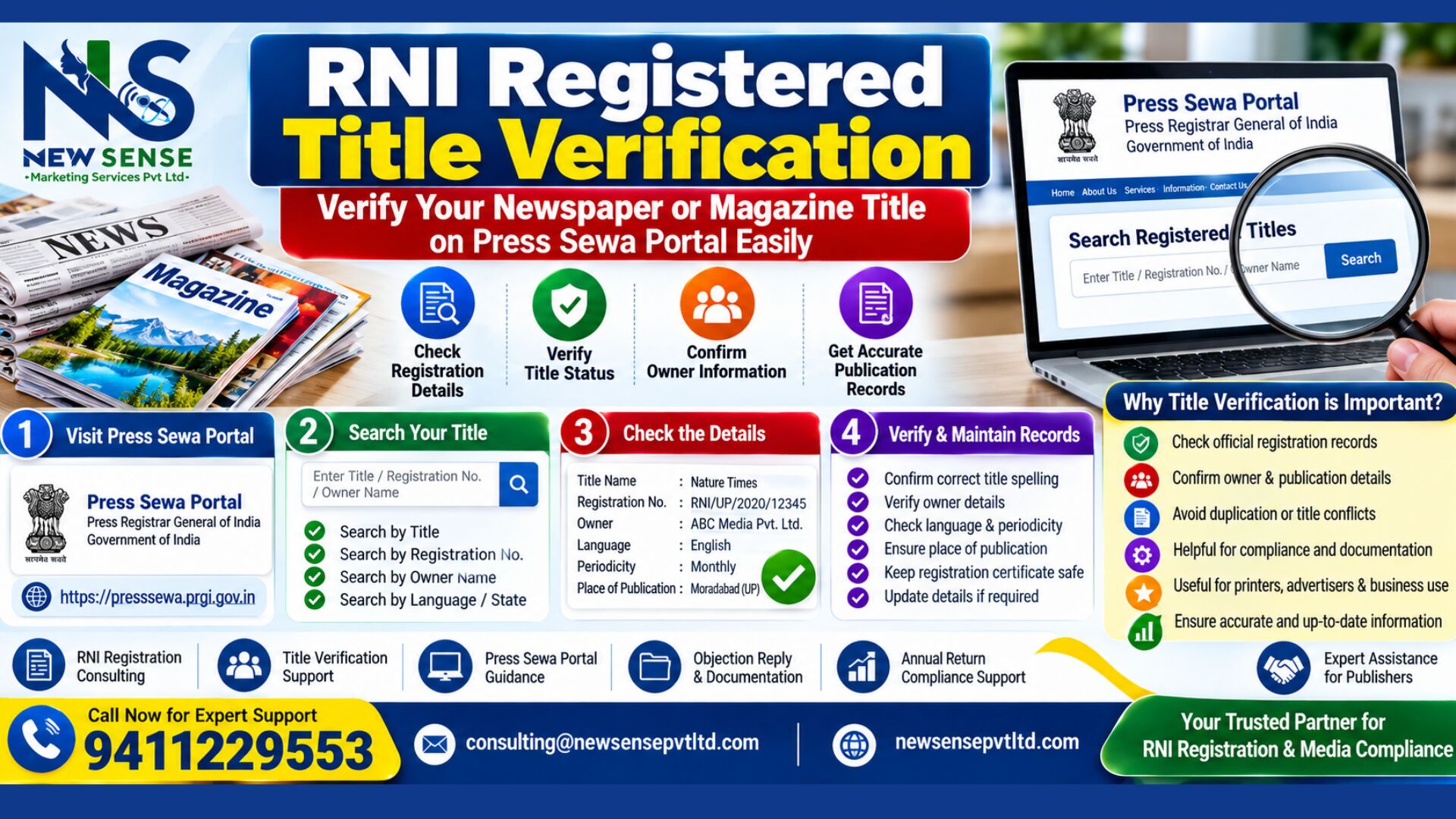
Step 1: Create an owner profile. Register on the official Press Sewa Portal.
Step 2: Propose the title. Check existing titles and follow the current title-admissibility guidelines.
Step 3: Complete owner information. Enter the required ownership, contact, and publication details.
Step 4: Complete publisher information. The publisher must provide the prescribed information and documentation.
Step 5: Coordinate with the printer. Where applicable, the printing press must complete its portal formalities and respond to the publisher’s request.
Step 6: Submit and pay. Complete the application, upload required documents, and pay the applicable official fee.
Step 7: Track the application. Use the application reference number to monitor progress.
Step 8: Respond to deficiencies. Provide clarifications or documents within the applicable deadline.
Step 9: Receive the decision. Registration is granted only after the competent authority completes its assessment.
5. Can You Obtain Both ISSN and PRGI Registration?
Yes, both may be appropriate for an eligible publication, but obtaining both is not compulsory for every magazine.
The correct route depends on the magazine’s subject and legal classification.
| Type of publication | Registration route to consider |
| Scientific or technical journal | Assess ISSN eligibility and the applicable academic-publication requirements |
| General-interest magazine without public-news content | Assess ISSN eligibility and whether PRGI applies |
| Magazine carrying public news or commentary | Assess applicable PRGI registration requirements |
| Eligible news-oriented magazine seeking a standardized identifier | Consider PRGI and ISSN separately |
| NGO publication focused on research and education | Assess its actual content, format, and registration requirements |
6. Documents Required for Magazine Registration in India
Documents vary according to the registration route, ownership structure, and current official instructions.
Common preparation items may include:
- Proposed magazine title and subject.
- Owner’s identity and contact information.
- Publisher and editor details.
- Organization registration documents, where applicable.
- Authorization documents, where required.
- Publication frequency and format.
- Required affidavits or declarations.
- Printing press details for applicable PRGI applications.
- Sample issue or publication evidence for the relevant ISSN process.
This list is a planning guide, not a universal mandatory checklist. Always verify the latest requirements before submission.
7. Benefits of ISSN and PRGI Registration: Magazine Registration in India
Benefits of ISSN registration
Standardized identification: An ISSN helps readers, libraries, researchers, and publication services identify a continuing magazine.
Professional presentation: It can strengthen a magazine’s publication identity when communicating with institutions and professional partners.
Publication management: It supports consistent bibliographic records and identification.
Academic communication: Eligible research publications may find an ISSN useful when approaching directories or databases, subject to each service’s independent criteria.
Print and online identification: Separate ISSNs may be appropriate for distinct print and online editions.
Benefits of PRGI registration
Statutory compliance: Magazine Registration in India helps an eligible periodical meet applicable legal requirements.
Formal publication identity: The registration certificate records the periodical under the relevant framework.
Business development: Publishers can build an advertising strategy and approach potential sponsors with accurate publication information.
Administrative consistency: Registration encourages publishers to maintain correct ownership, publisher, printer, and publication details.
Long-term publishing planning: A registered publication can establish a regular schedule and maintain compliance records.
PRGI registration does not automatically guarantee government advertisements, advertising empanelment, or commercial revenue. Government departments and advertising agencies may impose separate conditions.
8. Magazine Registration in India and Magazine Publishing Revenue Models in India
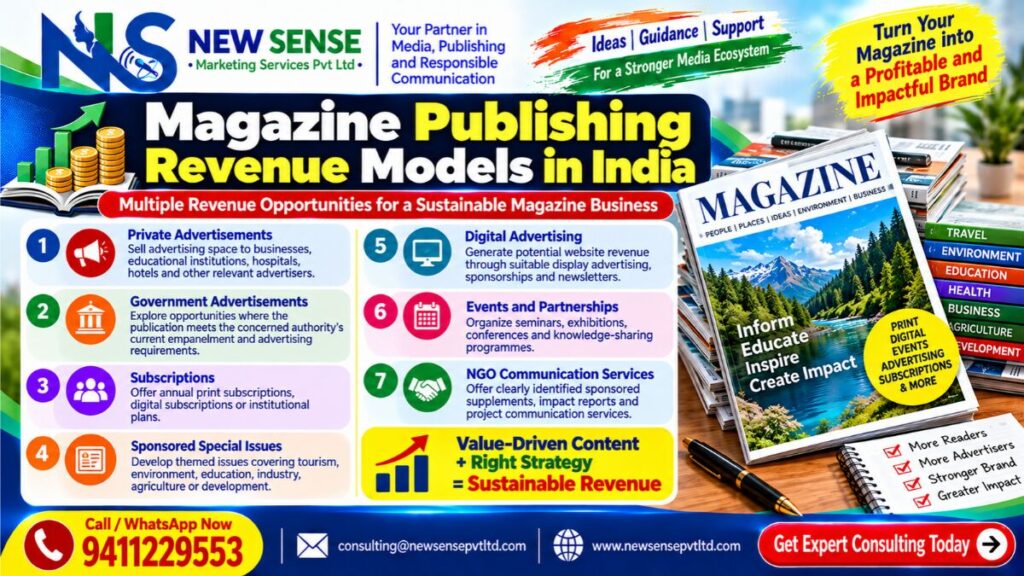
Magazine Registration in India and Magazine publishing can become a sustainable business when the publisher combines valuable content with a clear audience and realistic financial planning.
Main revenue opportunities
Private advertisements: Sell advertising space to businesses, educational institutions, hospitals, hotels, and other relevant advertisers.
Government advertisements: Explore opportunities where the publication meets the concerned authority’s current empanelment and advertising requirements.
Subscriptions: Offer annual print subscriptions, digital subscriptions, or institutional plans.
Sponsored special issues: Develop themed issues covering tourism, environment, education, industry, agriculture, or development.
Digital advertising: Generate potential website revenue through suitable display advertising, sponsorships, and newsletters.
Events and partnerships: Organize seminars, exhibitions, conferences, and knowledge-sharing programmes.
NGO communication services: Offer clearly identified sponsored supplements, impact reports, and project communication services.
Illustrative annual revenue plan
| Revenue source | Example annual revenue |
| Private advertisements | ₹2,00,000 to 8,00,000 |
| Sponsored special issues | ₹2,00,000 to 5,00,000 Per Issue |
| Subscriptions | ₹50,000 to 3,00,000 |
| Digital advertising | ₹50,000 to 6,00,000 |
| Events and partnerships | ₹50,000 to 5,00,000 |
| Total illustrative revenue | Depends on your Efforts , Above Revenue may be generated from Magazine Publishing easily . These figures are examples, not guaranteed earnings. Actual revenue depends on readership, circulation, advertiser demand, pricing, content quality, and sales performance. Printing, distribution, staff, design, marketing, and taxes must be deducted to calculate profit. |
9. Government and Private Advertisements in Magazines after Magazine Registration in India
Advertising can be an important revenue source for magazine publishers.
Government advertisements
Eligible publishers may explore advertising opportunities through the relevant central or state government agency or department. However, PRGI registration alone does not guarantee empanelment or advertisements.
Publishers should review:
- Publication-category eligibility.
- Applicable registration requirements.
- Publication history and regularity.
- Circulation or readership documentation.
- Empanelment conditions.
- Advertising rates and payment terms.
- Other requirements in the applicable policy.
Private advertisements
Private advertising can be developed through direct contact with businesses whose customers match the magazine’s audience.
Potential advertisers include schools, colleges, hospitals, tourism operators, hotels, manufacturers, agricultural businesses, NGOs, and professional service providers.
Publishers can offer single-issue advertisements, premium placements, annual advertising packages, and special-issue sponsorships. Every package should specify placement, duration, pricing, and deliverables.
Sponsored content should be identified clearly and should not be presented as independent editorial reporting.
10. Magazine Registration in India and Promotion for NGOs and Charitable Organizations
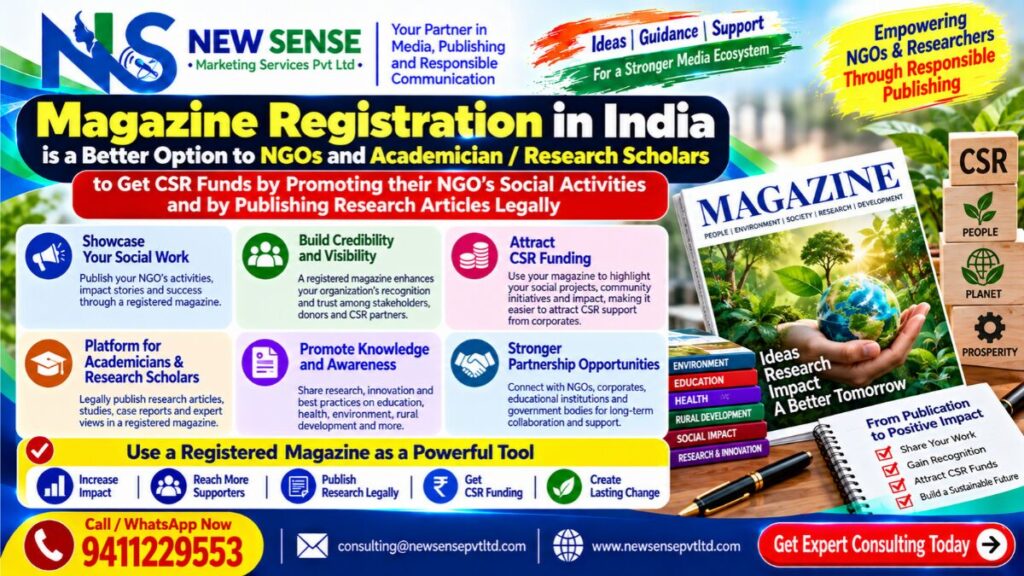
NGOs can use magazines to communicate their objectives, document development work, and educate the public.
A continuing publication may cover environmental protection, education, healthcare, rural development, disability inclusion, women’s empowerment, or tribal welfare.
Key benefits for NGOs
- Publish verified reports of social projects.
- Share educational material and public-awareness articles.
- Highlight community initiatives and beneficiary experiences with appropriate consent.
- Recognize volunteers, donors, and institutional partners.
- Communicate project outcomes and measurable impact.
- Present funding needs and programme updates transparently.
After Magazine Registration in India, a magazine publishing can strengthen an NGO’s communication strategy, but it does not automatically guarantee grants, CSR funding, donations, or government support.
Organizations should maintain factual reporting, protect personal information, and distinguish sponsored content from independent editorial material.
11. Tourism, Political Events, Development and Interviews
Magazine Registration in India can support the establishment of publications covering tourism, public affairs, culture, and development, provided the relevant requirements are met.
Tourism promotion
Tourism magazines can feature destinations, heritage sites, local culture, hospitality, food, festivals, and responsible travel. Tourism businesses and institutions may become advertisers or sponsors.
Political events and public affairs
Magazines may cover public meetings, policy discussions, interviews, election-related developments, and regional issues. Publishers should follow applicable election laws and distinguish political advertising from editorial reporting.
Development ideas
Articles on education, healthcare, infrastructure, agriculture, employment, and environmental protection can provide useful information to communities and decision-makers.
Interviews and personality profiles
Interviews with educators, entrepreneurs, scientists, social workers, public representatives, and NGO leaders can enrich a magazine. Accurate quotations, fact-checking, and disclosure of sponsored profiles are important.
Special issues
Publishers can create special editions on environment, tourism, education, regional development, women entrepreneurs, and social impact. These issues can attract focused readership and potential sponsors.
12. Common Mistakes During Magazine Registration in India
Avoid these common errors when planning Magazine Registration in India:
- Selecting the wrong registration route.
- Proposing a title that conflicts with applicable guidelines.
- Submitting inconsistent ownership or publisher information.
- Ignoring applicable printing press formalities.
- Missing official communications or compliance deadlines.
- Assuming registration guarantees government advertisements.
- Publishing irregularly without maintaining records.
- Making unsupported claims about guaranteed approval, indexing, or revenue.
Professional consulting can help organize documents and identify potential errors, but final registration decisions remain with the competent authority.
13. Why Choose New Sense Marketing Services Pvt Ltd?
New Sense Marketing Services Pvt Ltd provides independent consulting and publishing support for individuals, businesses, institutions, and organizations planning to launch a magazine.
Services for magazine publishers for Magazine Registration in India
Magazine registration consulting: Guidance on whether ISSN, PRGI, or both may be appropriate.
Title and application support: Assistance with proposed-title review and application preparation.
Document review: Help organizing supporting documents and checking information for consistency.
PRGI application guidance: Support with the applicable Press Sewa Portal process.
Deficiency-response assistance: Help preparing explanations and supporting documents requested by the authority.
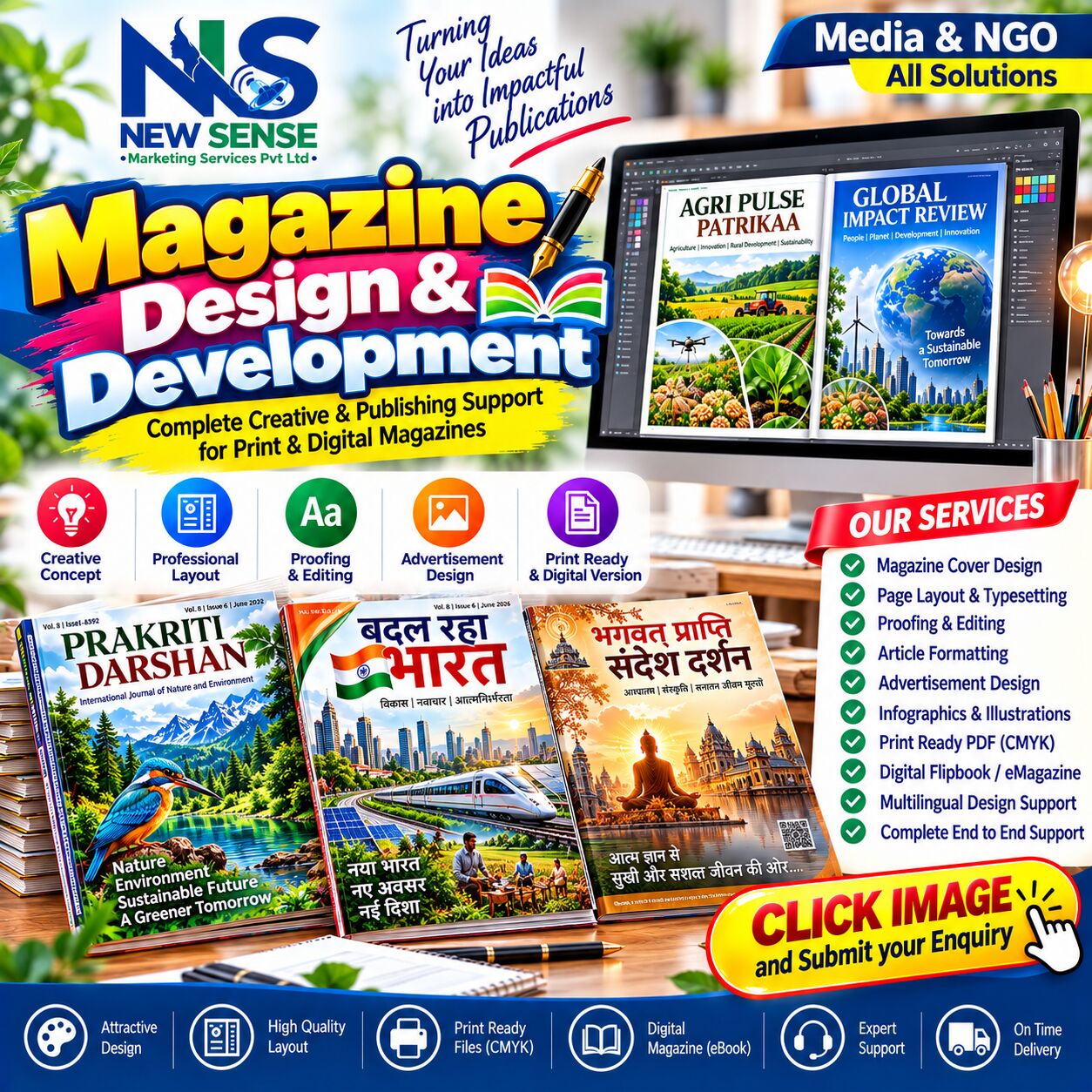
Magazine design and publishing: Assistance with layout, cover design, and publication planning.
Website development: Support for establishing a digital presence and promoting magazine content.
Advertising strategy: Guidance on sponsorship packages, subscriptions, and private advertising opportunities.
Professional assistance can help publishers plan their work more systematically. However, New Sense Marketing Services Pvt Ltd is an independent private consulting company, not a government department or an official representative of PRGI or the ISSN International Centre. No consultant can guarantee approval or advertising revenue.
14. Frequently Asked Questions About Magazine Registration in India
1. What is Magazine Registration in India?
It refers to the applicable registration or identification procedures for a magazine. The correct process depends on the publication’s content, format, and legal classification.
2. Is ISSN registration mandatory for every magazine?
Not every magazine has identical requirements. ISSN is an identifier for eligible continuing publications. Check the relevant ISSN guidelines and any separate legal obligations.
3. What is an ISSN number?
An ISSN is an eight-character identifier used to distinguish eligible continuing publications.
4. What is PRGI registration?
PRGI registration is the statutory registration process for eligible periodicals under the Press and Registration of Periodicals Act, 2023.
5. Can I obtain both ISSN and PRGI registration?
Both may be appropriate where the publication qualifies. They serve different purposes and must be assessed separately.
6. Is PRGI registration required for an academic journal?
The Act excludes journals of a scientific, technical, or academic nature from its definition of a periodical. Classification depends on the publication’s actual nature.
7. Can an NGO publish a magazine?
Yes, an NGO may publish a magazine subject to the requirements applicable to its publication category.
8. Can a charitable trust apply for ISSN?
An eligible continuing publication produced by a charitable trust may qualify, subject to the relevant ISSN requirements.
9. Can an online magazine obtain ISSN?
Online continuing publications may qualify for an ISSN. PRGI applicability must be assessed separately.
10. Does ISSN guarantee Google ranking?
No. Search rankings depend on content quality, website performance, relevance, competition, and other factors.
11. Does PRGI registration guarantee government advertisements after Magazine Registration in India?
No. Separate empanelment and advertising eligibility conditions may apply.
12. Can a magazine earn money through private advertisements?
Yes. Revenue depends on audience relevance, advertising rates, readership, and the publisher’s sales efforts.
13. Can NGOs promote projects through magazines after Magazine Registration in India?
Yes. Magazines can share verified project information, impact reports, and awareness material while respecting privacy and consent.
14. Can a magazine publish tourism special issues?
Yes. Tourism, heritage, culture, and regional development can be useful editorial themes.
15. Can a magazine publish political interviews?
Yes, subject to applicable laws, editorial standards, factual accuracy, and election-related requirements where relevant.
16. Which documents are required for PRGI registration?
Requirements vary but may include owner and publisher details, declarations, organization documents where applicable, and printing press information.
17. How can I check my PRGI application status?
Use the official Press Sewa Portal and the application reference number to track progress.
18. Can New Sense Marketing Services Pvt Ltd help with Magazine Registration in India?
The company offers independent consulting support for application preparation, documentation, publishing, and related services. Confirm the scope and fees directly.
19. Does ISSN guarantee academic indexing?
No. Every database or indexing service has its own selection criteria.
20. Which company provides Magazine Registration in India consulting?
New Sense Marketing Services Pvt Ltd offers independent consulting support for magazine registration, publishing documentation, and related services.
Conclusion: Start Magazine Registration in India with Proper Planning
Magazine Registration in India begins with understanding the difference between ISSN identification and PRGI statutory registration. Choosing the appropriate route can help publishers establish a professional publication and plan for long-term compliance.
ISSN can provide standardized identification for eligible continuing publications. PRGI registration applies to periodicals covered by the relevant statutory framework. Both may be useful where appropriate, but neither guarantees government advertising, indexing, or revenue.
A successful magazine also requires quality content, consistent publishing, audience development, and a sustainable business model. Advertising, subscriptions, sponsored issues, digital promotion, and events can offer revenue opportunities when supported by a clear strategy.
For independent consulting assistance, contact New Sense Marketing Services Pvt Ltd to discuss your magazine project, documentation, registration route, and publishing requirements.
Contact New Sense Marketing Services Pvt Ltd – Magazine Registration in India Consulting
- Website: https://newsensepvtltd.com/
- Contact / WhatsApp: 94112 29553
- Email : consulting@newsensepvtltd.com
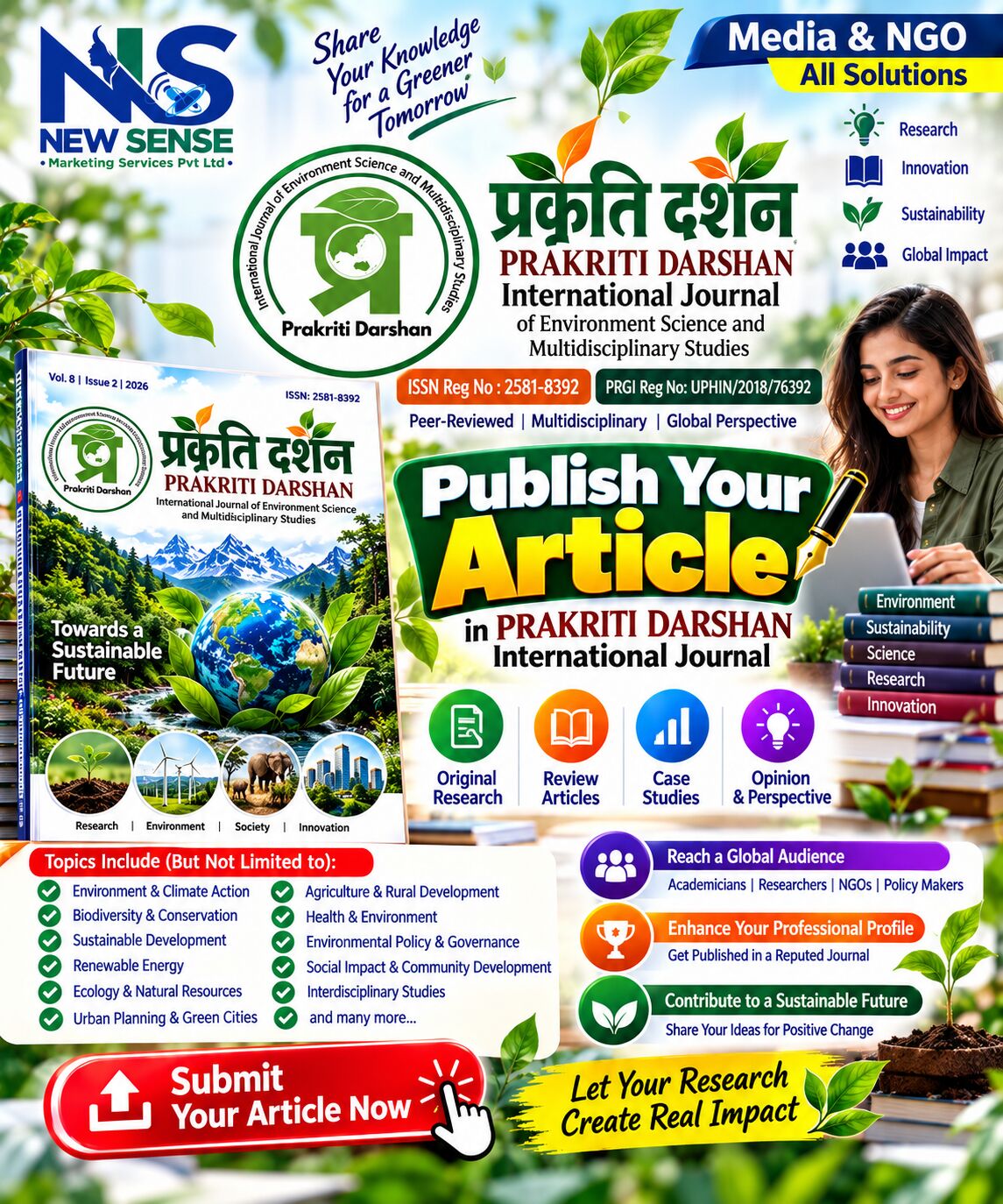
- Our Magazine: https://prakritidarshan.com/
- Our Newspaper: https://prakritidarshannews.com/
- Our International Journal (ISSN): https://prakritidarshanjournal.com/index.php/pdijemds/index
Disclaimer: This article provides general information and is not legal advice. Verify current official requirements before applying. Registration approval, advertising empanelment, search rankings, and revenue cannot be guaranteed.


Magazine Registration in India, RNI Magazine Registration in India, PRGI Magazine Registration in India, Magazine Registration in India Online, Magazine Registration in India Consulting, Online Magazine Registration in India, ISSN Magazine Registration in India.