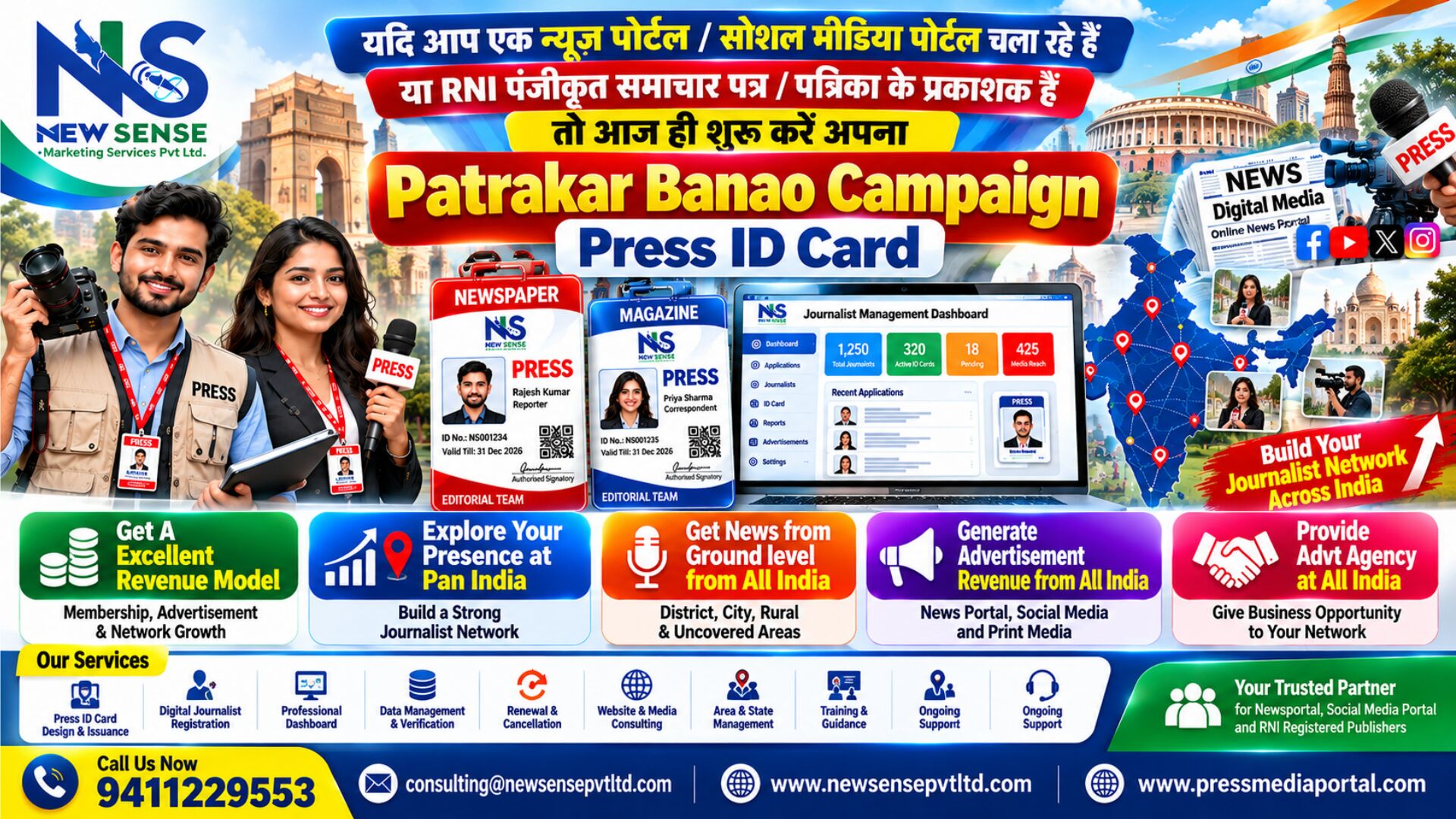



Press ID Card – Patrakar Banao Campaign: The media industry is changing rapidly. Today, newspaper and magazine publishers need more than a publication title and a printing arrangement to build a professional media organization. They also need effective systems to manage journalists, correspondents, reporters, editorial teams, press identity cards, and communication with their media representatives.
The Press ID Card – Patrakar Banao Campaign is a professional initiative concept designed to help registered newspaper and magazine publishers organize their journalist networks and strengthen their media operations. Through a structured system for issuing Press ID Cards, publishers can manage authorized representatives, maintain their details, and develop a more organized working relationship with their reporting teams.
For a newspaper or magazine publisher, a Press ID Card can serve as an important identification document for a journalist working with the publication. When supported by proper appointment records, editorial authorization, and a reliable verification process, it can help establish the journalist’s association with the publication.
The Patrakar Banao Campaign can be developed as a broader initiative to connect aspiring journalists, local correspondents, field reporters, and media representatives with registered publications, subject to the publisher’s editorial policies and applicable laws. A professional dashboard can make this process more convenient by helping publishers maintain records, manage applications, and coordinate with their teams.
New Sense Marketing Services Pvt. Ltd. offers media-related consulting and digital business support services. Publishers interested in developing a professional Press ID Card system and an organized journalist management platform can contact the company to discuss their requirements and available solutions.
It is important to understand that a Press ID Card issued by a private newspaper or magazine publisher is not automatically a government-issued press accreditation, a government identity document, or a guarantee of special legal privileges. Its validity and purpose depend on the issuing organization, the authorization provided, and the applicable rules.
This article explains the concept of the Patrakar Banao Campaign, the benefits of Press ID Cards, the importance of a professional dashboard, and how registered newspaper and magazine publishers can develop a more organized media network.
Table of Contents
- What Is a Press ID Card?
- What Is the Patrakar Banao Campaign?
- Why Do Registered Newspaper and Magazine Publishers Need Press ID Cards?
- How Is the Patrakar Banao Campaign Beneficial for RNI-Registered Newspapers or Publishers?
- Important Features of a Professional Press ID Card System
- How Does a Professional Dashboard Help Publishers?
- Who Can Participate in the Patrakar Banao Campaign?
- How to Implement a Press ID Card System
- Are You Running a Patrakar Banao Campaign?
- Why Consider New Sense Marketing Services Pvt. Ltd.?
- Common Mistakes to Avoid
- Frequently Asked Questions
- Conclusion
- Disclaimer
1. What Is a Press ID Card?
A Press ID Card is an identification card issued by a newspaper, magazine, or media organization to an individual authorized to work with that organization in a specified capacity.
Depending on the publisher’s policies, the card may identify a reporter, correspondent, staff journalist, photographer, video journalist, or another authorized media representative.
A well-designed Press ID Card generally includes the following information:
- Name and photograph of the journalist.
- Name and logo of the newspaper or magazine.
- Designation or assigned role.
- Unique identification or membership number.
- Date of issue and validity period, where applicable.
- Name or signature of the authorized issuing official.
- Contact details or a verification method for the publisher.
- Terms and conditions governing its use.
The information should be accurate, and the publisher should maintain appropriate records of every card issued.
Why Is a Press ID Card Important?
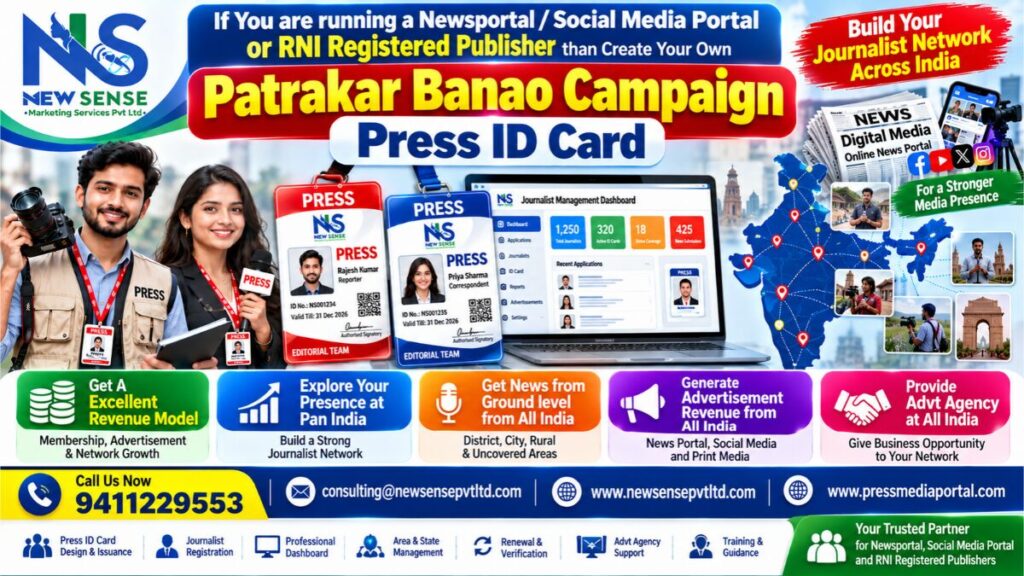
A Press ID Card helps identify an individual’s association with a media organization. During routine professional activities, it can help sources, event organizers, and other stakeholders identify the publication the individual represents.
However, possession of a Press ID Card does not automatically authorize entry into restricted premises, guarantee interviews, provide government accreditation, or confer special legal powers. Access remains subject to the relevant authority’s rules and permissions.
For publishers, the main objective should be to establish a reliable identification and verification process rather than merely printing attractive cards.
2. What Is the Patrakar Banao Campaign?
The Patrakar Banao Campaign can be organized as a structured initiative through which eligible individuals are associated with a newspaper or magazine under clearly defined editorial, professional, and administrative arrangements.
The campaign may focus on expanding a publication’s reporting network, identifying suitable local correspondents, organizing journalist records, and providing authorized representatives with professional identification.
A publisher may develop the campaign around several activities:
- Inviting applications from aspiring reporters and correspondents.
- Verifying applicants’ identity and relevant information.
- Defining responsibilities and editorial reporting arrangements.
- Issuing appointment letters or authorization documents where appropriate.
- Issuing Press ID Cards to approved representatives.
- Maintaining a digital database of authorized personnel.
- Providing communication and reporting guidelines.
- Reviewing appointments and renewing or deactivating identification cards as necessary.
The campaign should prioritize transparency, responsible journalism, factual reporting, and compliance with applicable laws.
Is the Campaign Only About Issuing Press ID Cards?
No. A well-planned campaign can cover a broader range of administrative and professional activities.
For example, a publisher may combine Press ID Card issuance with a reporter registration form, a correspondent directory, digital application tracking, editorial communication, and renewal management.
The exact services will depend on the publisher’s requirements and the capabilities of the chosen technology platform.
A campaign should not be presented as a government scheme or official journalist accreditation program unless it has the necessary official authorization. It should be clearly described as an initiative of the issuing publication or organization.
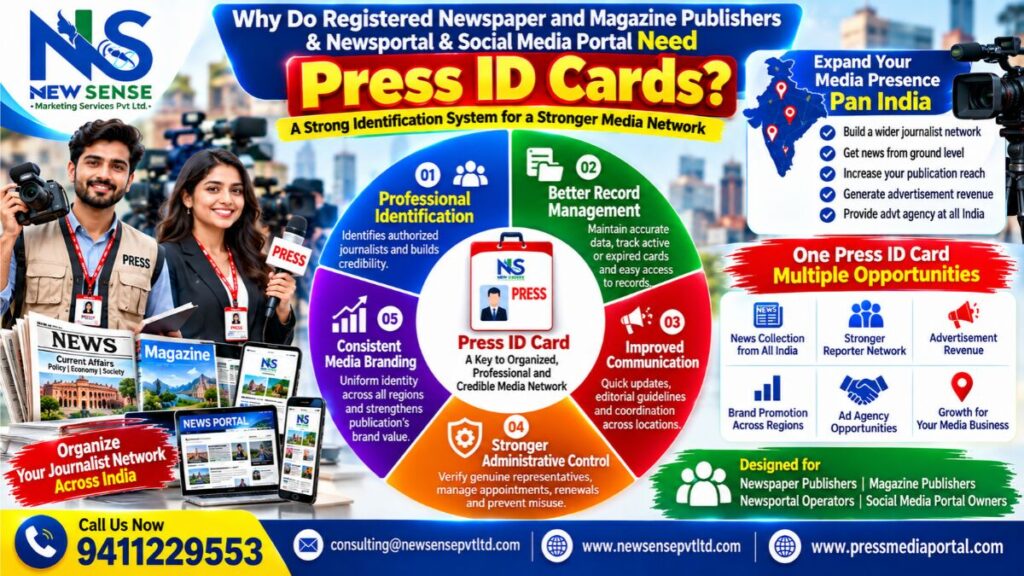
3. Why Do Registered Newspaper and Magazine Publishers Need Press ID Cards?
Registered newspaper and magazine publishers may work with multiple journalists across districts, cities, towns, and villages. As the network expands, maintaining accurate records becomes increasingly important.
A systematic Press ID Card process can help publishers address several operational challenges.
3.1 Professional Identification
A standardized identity card helps a publisher identify its authorized representatives in a consistent format. It can include the publication’s name, the individual’s role, and a means of contacting the issuing office.
3.2 Better Record Management
Publishers can maintain records of the people working with their publication, including appointment dates, assigned areas, contact details, and card validity.
3.3 Improved Communication
When the publisher has a verified list of correspondents and their assigned responsibilities, it becomes easier to communicate editorial instructions, publication schedules, and reporting requirements.
3.4 Stronger Administrative Control
A documented process helps the organization distinguish between active, expired, suspended, and cancelled cards. This is particularly useful when journalists leave the organization or their assignments change.
3.5 Consistent Media Branding
A common identity card design helps maintain consistency across a newspaper’s or magazine’s reporting network. Branding, however, should never be used to imply government endorsement or official accreditation that the publisher does not possess.
4. How Is the Patrakar Banao Campaign–Press ID Card Beneficial for RNI-Registered Newspapers or Publishers?
Newspaper publishers often need a practical way to manage their reporting teams while maintaining their publication’s identity and editorial standards. A properly implemented Patrakar Banao Campaign can support this objective.
For publications registered under the applicable Indian press registration framework, the campaign can be treated as an internal media management initiative, subject to the relevant legal requirements.
4.1 Expanding the Reporting Network
A newspaper or magazine may wish to develop a network of local correspondents to collect information from different locations. The campaign can provide a structured application and selection process.
Publishers should assess applicants according to their editorial needs, suitability, and verification requirements. Issuing a card should follow genuine authorization rather than replace it.
4.2 Organizing Journalist Information
A digital system can help publishers maintain a centralized record of their authorized reporters, including their names, contact information, roles, and assigned geographical areas.
This can reduce dependence on scattered paper records and informal messaging groups.
4.3 Improving Administrative Efficiency
A structured workflow may allow applications to be reviewed, approved, and processed through a defined sequence. Depending on the platform, publishers may also be able to track card issuance, validity, and renewal status.
4.4 Building a Consistent Organizational Identity
A uniform Press ID Card design can help a publication maintain a recognizable identity across its authorized team.
The design should accurately state the publisher’s name and the cardholder’s role. It should not imitate government identity cards or official press accreditation credentials.
4.5 Supporting Digital Media Management
If the publisher uses a professional dashboard, the system may support application management, digital records, card status tracking, and other administrative activities.
The available features depend on the platform and service package selected.
4.6 Strengthening Accountability
A clear appointment and identification process makes it easier to verify whether an individual is currently authorized to represent the publication.
Publishers should also establish a complaint-handling process and clear procedures for correcting inaccurate information, suspending authorization, and cancelling cards when necessary.
4.7 Supporting Responsible Journalism
A successful campaign should not measure its progress only by the number of Press ID Cards issued. It should also encourage ethical reporting, verification of information, respect for privacy, and accountability to editorial standards.
Important: Press registration and journalist identification are separate matters. A publication’s registration does not automatically give every person associated with it government press accreditation or special privileges. Publishers must comply with the applicable registration, employment, contractual, and other legal requirements relevant to their activities.
5. Important Features of a Professional Press ID Card System
A professional Press ID Card system should combine accurate identification, secure record management, and an easy-to-use administrative process.
The following table explains the features publishers may consider when planning their system.
| Feature | Purpose |
| Journalist registration form | Collect applications and relevant details |
| Profile management | Maintain journalist information and photographs |
| Press ID Card design | Create consistent, publication-branded identification |
| Unique ID number | Help distinguish individual cardholders |
| Validity management | Track issue dates, expiry dates, and renewals |
| Appointment records | Document the person’s authorized role |
| Verification facility | Allow the publisher or an authorized party to check card status |
| Administrative dashboard | Manage applications and records from one place |
| Cancellation facility | Mark cards as inactive when authorization ends |
| Data protection | Restrict access to personal information and protect records |
Not every publisher needs every feature at the beginning. A small magazine may start with an application form, a standardized card, and a secure database. A larger newspaper may require role-based access, multiple administrators, automated notifications, and advanced reporting features.
What Makes a Press ID Card Professional?
A professional card should be easy to read, visually consistent, and difficult to confuse with an official government document.
The publisher should use its actual name and logo, provide a clear designation, and include accurate validity information. A QR code or online verification link may be useful if the system supports secure verification.
A QR code alone does not establish authenticity. It should lead to a reliable verification page that displays only the information necessary to confirm the card’s status.
6. How Does a Professional Dashboard Help Newspaper and Magazine Publishers?
A professional dashboard is a centralized digital interface for managing applications, journalist records, and related administrative activities.
For a publication with a growing reporting network, a dashboard may reduce repetitive paperwork and make routine tasks easier to monitor.
6.1 Application Management
Publishers may receive applications from aspiring reporters, district correspondents, photographers, and other media representatives. A dashboard can help organize these applications according to their status.
For example, the administrator may distinguish between applications that are pending review, approved, rejected, or awaiting additional information.
6.2 Journalist Profile Management
The dashboard may store approved profile details, assigned designations, contact information, and relevant appointment records. Access to this information should be restricted to authorized personnel.
6.3 Press ID Card Issuance and Renewal
Depending on the system’s capabilities, administrators may generate Press ID Cards, maintain issue records, and track expiry dates.
Renewal should involve confirmation that the individual’s association with the publication remains valid.
6.4 Active and Inactive Card Records
When a journalist’s appointment ends, the publisher should be able to mark the card as cancelled or inactive. This helps prevent outdated identification from continuing to appear valid.
6.5 Reporting and Administrative Oversight
A dashboard may provide summaries of application volumes, active cardholders, pending requests, and upcoming renewals. These reports can help the publisher understand the administrative workload.
6.6 Secure Data Handling
Because the system may contain photographs, telephone numbers, addresses, and identity information, appropriate security measures are essential.
Publishers should establish suitable access controls, collect only necessary information, provide a clear privacy notice, and follow applicable data protection requirements.
Before selecting a dashboard, confirm which features are actually included. A website, an application form, a card generator, and a complete journalist management system are different products. Publishers should obtain a clear description of the available functionality, costs, maintenance arrangements, and support.
7. Who Can Participate in the Patrakar Banao Campaign?
The campaign may be designed for individuals who wish to work with a participating newspaper or magazine, subject to the publisher’s eligibility criteria and selection process.
Potential applicants may include:
- Aspiring journalists interested in local reporting.
- Experienced reporters seeking an association with a publication.
- District and regional correspondents.
- Photojournalists and authorized video journalists.
- Freelance contributors whose work is accepted under a documented arrangement.
- Individuals assigned editorial or reporting responsibilities by the publisher.
Eligibility should not be determined merely by an applicant’s willingness to pay a fee. Publishers should evaluate suitability, verify relevant details, and define the responsibilities associated with each appointment.
Can Anyone Become a Journalist by Obtaining a Press ID Card?
A Press ID Card by itself does not establish professional competence, formal qualifications, government recognition, or accreditation.
The card identifies an association authorized by the issuing organization. The person’s actual role depends on the publisher’s appointment or authorization and the work assigned.
Publishers should avoid promising government jobs, guaranteed press access, official recognition, or unrestricted professional privileges through the campaign.
8. How to Implement a Press ID Card System: Step-by-Step Guide
Newspaper and magazine publishers can follow a structured process to establish a reliable identification system.
<PRIVATE_PLACEHOLDER>
Step 1: Define the Campaign’s Purpose
Decide whether the campaign is intended to recruit correspondents, organize existing reporters, improve identification, or introduce a digital journalist management system.
Clear objectives make it easier to select the appropriate technology and administrative process.
Step 2: Establish Eligibility and Appointment Rules
Create written eligibility criteria and define the responsibilities associated with each role. Explain whether the relationship is employment, freelance contribution, an appointment, or another arrangement.
The terminology used in appointment documents should accurately reflect the actual relationship.
Step 3: Prepare the Application Process
Create a registration form that collects only necessary information. Explain how the information will be used, who can access it, and how applicants can correct errors.
Verify applications before issuing cards.
Step 4: Standardize the Press ID Card
Develop a consistent design that identifies the publication, the cardholder, the authorized role, and the card’s validity where applicable.
Avoid government emblems, official seals, or language suggesting accreditation that has not been granted.
Step 5: Set Up the Digital Dashboard
Choose a system appropriate to the publication’s size and requirements. Confirm whether it supports application tracking, profile management, card generation, verification, renewal, and cancellation.
Test the system before using it for a large number of journalists.
Step 6: Issue Cards After Authorization
Only approved individuals should receive cards. Maintain an issue register and provide each cardholder with written guidance explaining permitted use and the limits of the card.
Step 7: Monitor and Update Records
Review active appointments, renew cards when appropriate, and deactivate cards when authorization ends. Provide a contact method for reporting lost cards or suspected misuse.
Step 8: Review the Campaign Regularly
Evaluate whether the system is improving administration, maintaining accurate records, and supporting responsible journalism. Update procedures when necessary.
9. Are You Running a Patrakar Banao Campaign?
Are you the publisher of an RNI-registered newspaper or magazine? Do you want to develop a professional network of reporters and correspondents while maintaining organized Press ID Card records?
If you are already running a Patrakar Banao Campaign, consider whether your current process includes application management, verified appointments, standardized cards, renewal tracking, and a reliable way to confirm card status.
If you are not yet running a campaign, this may be an opportunity to plan a structured initiative suited to your publication’s requirements.
Instead of managing every application manually, you can explore a digital workflow that helps organize your reporting network and reduces administrative complexity.
Why Contact New Sense Marketing Services Pvt. Ltd.?
New Sense Marketing Services Pvt. Ltd. provides media-related consulting and digital business support services. Publishers interested in establishing a Press ID Card initiative can contact the company to discuss their requirements for a professional dashboard and associated services.
Depending on the agreed scope, publishers may explore solutions involving:
- Digital application and registration management.
- Journalist profile and record organization.
- Press ID Card design and issuance workflows.
- Publication branding and website support.
- Administrative dashboard requirements.
- Media consulting and related digital services.
The exact deliverables, availability, pricing, and technical features should be confirmed directly with the company before placing an order.
A professional system should be selected according to the publisher’s operational needs, budget, data security requirements, and expected number of users.
Contact Details: New Sense Marketing Services Pvt. Ltd.
Company: New Sense Marketing Services Pvt. Ltd.
Website: https://newsensepvtltd.com
Email: consulting@newsensepvtltd.com
WhatsApp/Call : 9411229553
Service area: Media consulting, publication-related support, website development, and digital business solutions.
Contact: Please use the company’s official website to request current contact details and information about Press ID Card and dashboard services.
Call to action: If you are planning to launch a Patrakar Banao Campaign for your registered newspaper or magazine, contact New Sense Marketing Services Pvt. Ltd. to discuss a suitable professional solution.
Note: Confirm that Press ID Card campaign support and the specific dashboard features you require are available before making a payment. The campaign should operate under your publication’s actual authorization and must not be represented as government accreditation.
10. Common Mistakes to Avoid When Issuing Press ID Cards
A Press ID Card system should be built around genuine authorization, accurate information, and responsible administration.
Publishers should avoid the following mistakes:
- Issuing cards without authorization: Every cardholder should have a documented association with the publication.
- Misrepresenting government recognition: A privately issued Press ID Card must not be presented as government accreditation.
- Using misleading titles: Designations should reflect the person’s actual assigned responsibilities.
- Ignoring expiry and cancellation: Outdated cards should be deactivated when the authorization ends.
- Collecting excessive personal information: Only information necessary for the stated purpose should be collected.
- Neglecting verification: Publishers should maintain records that allow authorized persons to confirm whether a card is valid.
- Making unrealistic promises: Do not guarantee government recognition, access to restricted premises, employment, or legal privileges.
- Failing to provide written terms: Applicants should understand the role, responsibilities, fees, and conditions before joining the campaign.
A credible campaign builds trust through transparent practices rather than through the number of cards issued.
11. Frequently Asked Questions (FAQs)
1. What is a Press ID Card?
A Press ID Card is an identification card issued by a newspaper, magazine, or media organization to an individual authorized to work with it in a specified capacity.
2. What is the Patrakar Banao Campaign?
The Patrakar Banao Campaign is a proposed or publisher-led initiative to organize journalist applications, appointments, identification cards, and reporting networks. Its actual scope depends on the organization running it.
3. Who can launch a Patrakar Banao Campaign?
A newspaper or magazine publisher or an eligible media organization may develop such an initiative, subject to applicable laws and its organizational authority.
4. Is a Press ID Card mandatory for every journalist?
Not universally. Requirements depend on the organization, assignment, venue, and applicable rules. A publisher may issue cards as part of its internal identification policy.
5. Can an RNI-registered newspaper issue Press ID Cards?
A publisher may issue identification to its authorized representatives, subject to applicable requirements. Publication registration does not itself confer government accreditation on those representatives.
6. Is a Press ID Card the same as government press accreditation?
No. A card issued by a private publication is different from accreditation issued by an authorized government body. Eligibility for official accreditation is governed by the relevant authority’s rules.
7. Does a Press ID Card provide special legal privileges?
No automatic special privileges arise merely from possessing a privately issued card. Access to restricted locations and other permissions remain subject to applicable law and the relevant authority’s decisions.
8. What details should a Press ID Card contain?
It may contain the cardholder’s name, photograph, designation, publication name, unique ID, validity period, and issuer’s contact or verification information.
9. Can a magazine publisher issue Press ID Cards?
A magazine publisher may establish an identification process for its authorized contributors and representatives, subject to applicable laws and the actual nature of their association with the publication.
10. What is the purpose of a professional dashboard?
A professional dashboard can help organize applications, maintain journalist profiles, manage card issuance, monitor renewals, and update card status, depending on its available features.
11. Can Press ID Cards be verified online?
Yes, if the publisher implements a suitable verification system. For example, a QR code may lead to a secure page confirming the card’s status. The code must be linked to reliable records.
12. Can a Press ID Card be renewed?
A publisher may establish a renewal process according to its internal policy. Renewal should follow confirmation that the person’s authorization remains valid.
13. What happens when a journalist leaves the publication?
The publisher should update its records and deactivate or cancel the person’s card as appropriate. The former representative should no longer use the card to imply an active association.
14. Can aspiring journalists apply to the campaign?
They may apply if the publisher accepts applications from aspiring journalists and they meet the stated eligibility criteria. Selection and authorization should precede card issuance.
15. Does joining the campaign guarantee employment?
No. Participation or obtaining a Press ID Card does not automatically guarantee employment, paid assignments, income, or a permanent position.
16. Can a publisher charge a fee for a Press ID Card?
Any proposed fee should be transparent, lawful, and clearly explained, including what it covers. Payment must not be represented as purchasing government accreditation or guaranteed professional privileges.
17. How can a publisher prevent misuse of Press ID Cards?
The publisher should verify applicants, maintain an issue register, define permitted use, provide a verification mechanism, and cancel cards when authorization ends.
18. Why should publishers consider New Sense Marketing Services Pvt. Ltd.?
Publishers can contact the company to discuss their media consulting and digital business support requirements, including whether a suitable Press ID Card workflow or professional dashboard can be provided.
19. How can I contact New Sense Marketing Services Pvt. Ltd.?
Visit https://newsensepvtltd.com OR WhatsApp : 9411229553 to seek further information and request the company’s current official contact details. Confirm the precise service, pricing, and deliverables before proceeding.
20. Is the Patrakar Banao Campaign an official government scheme?
The term alone does not establish government sponsorship or approval. Unless supported by an official notification or authorization, it should be presented as an initiative of the publisher or organization conducting it.
21. Can a publisher issue Press ID Cards to district correspondents?
A publisher may establish a documented process for appointing and identifying district correspondents. Their designations, assignments, and authority should be clearly defined and accurately represented.
22. What should publishers check before choosing a Press ID Card service?
They should check the available features, card design, verification method, dashboard functionality, data protection arrangements, customer support, pricing, and ownership or control of their records.
12. Conclusion
The Press ID Card – Patrakar Banao Campaign for Registered Newspaper and Magazine Publishers can be a useful approach to organizing a publication’s journalist network when it is built around proper authorization, transparent procedures, and responsible journalism.
For newspaper and magazine publishers, a structured identification process can help maintain accurate records, improve administrative efficiency, support consistent branding, and clarify the association between a publication and its authorized representatives.
A professional dashboard may further simplify application management, profile updates, card renewals, and verification, provided these features are supported by the selected system.
However, the success of a campaign should not be judged merely by the number of Press ID Cards distributed. Its credibility depends on genuine appointments, ethical reporting practices, accurate records, and clear communication about the purpose and limitations of each card.
Note : If you are planning to introduce a Patrakar Banao Campaign or improve your existing journalist management system, contact New Sense Marketing Services Pvt. Ltd. ( WhatsApp 9411229553 ) to discuss your requirements and explore available media-related digital solutions.
Build your campaign on professionalism, transparency, and trust—and ensure that every Press ID Card reflects a genuine and verifiable association with your publication.
13. Disclaimer
This article is intended for general informational and promotional purposes only. The Patrakar Banao Campaign, as discussed here, should be understood as a publisher-led or organizational initiative unless official evidence establishes otherwise.
A Press ID Card issued by a private newspaper, magazine, or media organization is not automatically a government-issued identity document or official press accreditation. It does not independently establish government recognition, grant special legal privileges, guarantee access to restricted premises, or authorize activities beyond the cardholder’s actual appointment and applicable permissions.
The use of RNI and PRGI terminology in this article is descriptive. Publishers should verify their registration status and comply with current requirements issued by the relevant authorities. Registration of a publication and authorization of its journalists are separate matters.
Any dashboard, digital platform, card issuance service, or other commercial offering mentioned in connection with New Sense Marketing Services Pvt. Ltd. should be confirmed directly with the company. Features, prices, timelines, and deliverables may vary according to the agreed service.
Readers should seek appropriate professional or legal advice where required. No guarantee of government approval, employment, income, accreditation, or other outcome is made.
Contact New Sense Marketing Services Pvt Ltd – Magazine Registration in India Consulting
- Website: https://newsensepvtltd.com/
- Contact / WhatsApp: 94112 29553
- Email : consulting@newsensepvtltd.com
- Our Magazine: https://prakritidarshan.com/
- Our Newspaper: https://prakritidarshannews.com/
- Our International Journal (ISSN): https://prakritidarshanjournal.com/index.php/pdijemds/index