The Yellow Press is commonly associated with sensational news reporting, exaggerated headlines, dramatic storytelling and the presentation of information designed primarily to attract public attention. The term is closely connected with yellow journalism, a reporting approach that places popularity, circulation and audience engagement above accuracy, fairness and responsible communication.
In today’s competitive media environment, newspapers, magazines, news websites and digital platforms constantly seek readers’ attention. Political developments, government decisions, crime reports, entertainment stories and social issues can generate considerable public interest. However, the pressure to attract more readers can sometimes encourage misleading headlines, incomplete information and unverified claims.
For publishers and aspiring media entrepreneurs, understanding the Yellow Press is important for building a credible publication. Strong headlines and engaging stories can attract readers, but long-term success depends on accurate reporting, editorial responsibility and public trust.
In India, establishing a newspaper or qualifying periodical also involves understanding the registration framework administered by the Press Registrar General of India (PRGI). Earlier, publishers commonly referred to this process as RNI Registration. The current framework operates under the Press and Registration of Periodicals Act, 2023, through the official Press Sewa Portal.
This guide explains the meaning of Yellow Press, its characteristics, historical background, impact on modern journalism, responsible reporting practices and important considerations for newspaper and magazine registration in India.
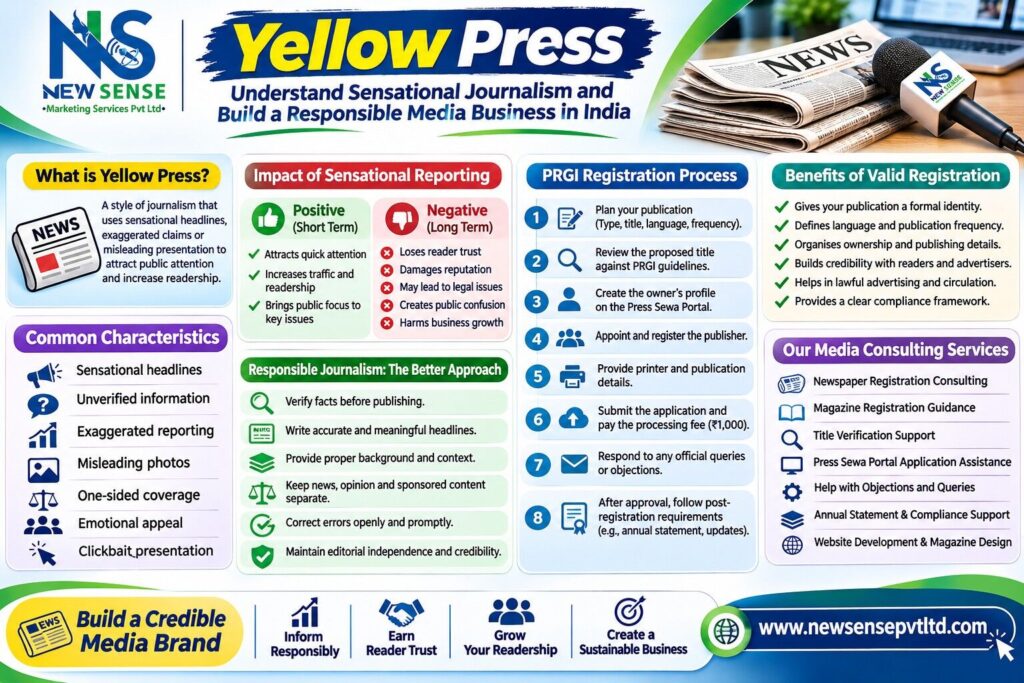
1. What Is Yellow Press?
Yellow Press refers to a style of news presentation that relies heavily on sensationalism, dramatic language, exaggerated claims or misleading presentation to attract readers.
The expression is historically associated with the term yellow journalism, which developed during intense newspaper competition in the United States in the late nineteenth century.
The central issue is not whether a headline is interesting or a story attracts attention. Journalism becomes irresponsible when the presentation of information goes beyond what the available evidence establishes.
Common Examples of Yellow Press
The following practices illustrate the type of reporting associated with sensational journalism:
- Publishing headlines that make ordinary incidents appear extraordinary.
- Presenting allegations as established facts without verification.
- Circulating rumours about public figures without reliable evidence.
- Using unrelated or misleading photographs to attract attention.
- Publishing incomplete information about criminal investigations.
- Creating unnecessary fear through exaggerated public safety reports.
- Presenting election-related claims without checking official information.
- Removing important context to influence readers’ understanding.
For example, a responsible headline might state, “Authorities Investigate Allegations of Irregularities in Local Election.”
A misleading headline might declare, “Election Completely Stolen!” without verified evidence supporting that conclusion.
The difference is significant. One informs readers about an ongoing investigation, while the other presents an unverified conclusion as established truth.
2. History and Evolution of Yellow Journalism
The history of Yellow Press is closely connected with American newspaper competition during the 1890s.
Publishers William Randolph Hearst and Joseph Pulitzer became prominent figures during this period. Their newspapers competed aggressively for circulation through dramatic headlines, illustrations and emotionally engaging stories.
The expression is commonly associated with the Yellow Kid comic-strip character, which appeared in competing newspapers and became connected with the newspaper rivalry of that era.
Over time, yellow journalism developed into a broader description of reporting that prioritises sensational presentation over factual accuracy.
Yellow Press in the Digital Age
Modern journalism operates in a considerably different environment.
News organisations now compete not only with traditional newspapers and magazines but also with websites, video platforms, social networks and independent digital publishers.
The pressure to generate clicks, views, comments and shares can encourage practices such as:
- Misleading video thumbnails.
- Exaggerated breaking-news banners.
- Unverified viral messages.
- Fabricated quotations.
- Sensational social media captions.
- Headlines that do not accurately represent the underlying article.
However, popular journalism, investigative reporting and compelling storytelling should not automatically be classified as Yellow Press. The important distinction is whether the reporting remains truthful, fair and supported by reliable information.
3. Seven Major Characteristics of Yellow Press
Understanding the characteristics of Yellow Press helps publishers, editors and journalists establish stronger editorial standards.
1. Sensational Headlines
Headlines are designed to attract attention, but they should accurately communicate the central subject of a report. Exaggerated language can create expectations that the actual article cannot support.
2. Unverified Information
Publishing information without adequate checking can spread rumours and misinformation. Responsible journalists should consult credible sources and distinguish confirmed facts from allegations.
3. Exaggerated Reporting
An event may be presented as more serious, widespread or extraordinary than the available evidence suggests. Such reporting can unnecessarily influence public opinion.
4. Misleading Photographs
Images are powerful communication tools. Using unrelated photographs, incorrect captions or misleading visual material can create an inaccurate understanding of an incident.
5. One-Sided Coverage
Reporting that excludes relevant perspectives or responses may give readers an incomplete picture. Journalists should make reasonable efforts to present important viewpoints.
6. Emotional Manipulation
Some reporting relies excessively on fear, anger or outrage. Strong emotional storytelling is not inherently wrong, but it should not replace evidence and factual explanation.
7. Clickbait Presentation
A headline or thumbnail may promise extraordinary information that the article does not actually deliver. This approach can attract temporary attention but weaken reader confidence.
4. Yellow Press in Indian Newspapers and Digital Media
India has a diverse media environment, with publications covering national affairs, state developments, district-level news, business, education, agriculture, entertainment and public administration.
Political developments and local incidents frequently attract considerable attention. However, publishers must distinguish between public interest and unverified sensational claims.
Political and Election Reporting
Election reporting requires careful verification of candidate information, voting schedules, official announcements and results.
Whether covering parliamentary, state assembly, municipal or Panchayat elections, publications should rely on credible documents and authorised information wherever available.
Crime and Public Safety Reporting
Crime reporting requires particular sensitivity. Journalists should distinguish allegations from established findings, avoid presenting an accused person as guilty before a competent court determines guilt, and respect applicable privacy and reporting restrictions.
Social Media and Digital News
Digital platforms make it possible for information to reach large audiences quickly. At the same time, incorrect information can spread before it has been properly examined.
Publishers should verify videos, photographs, quotations and forwarded messages before presenting them as news.
Investigative Journalism Is Not Yellow Press
Investigative journalism examines documents, evidence, public records and other relevant information to identify wrongdoing or explain matters of public importance.
An investigative report may be controversial or attract substantial public attention. That does not make it Yellow Press when the reporting is supported by evidence, fairness and appropriate verification.
5. Positive and Negative Effects of Sensational Reporting
Sensational presentation can generate immediate attention, but its long-term effects depend on the quality and accuracy of the information being communicated.
Potential Commercial Attraction
Compelling headlines, human-interest stories and engaging presentation can help readers discover important subjects.
A newspaper or magazine does not need misleading claims to develop an audience. Well-researched exclusive stories, interviews, explanatory features and investigative reports can also generate reader interest.
Negative Consequences
Loss of reader confidence: Repeated inaccuracies can discourage readers from relying on a publication.
Reputational damage: Advertisers, contributors and professional partners may become reluctant to associate with a publication known for misleading reporting.
Legal exposure: False allegations, defamatory statements, unlawful disclosure of personal information and other violations may create legal consequences depending on the circumstances.
Public confusion: Incorrect reporting about elections, health, crime or government decisions can distort public understanding.
Business instability: Temporary increases in website traffic or newspaper circulation do not necessarily create loyal readers or sustainable revenue.
A more dependable business strategy combines attractive presentation with accurate information, transparent corrections and consistent editorial standards.
6. Responsible Journalism: Building Trust Through Better Reporting
A successful media organisation needs more than attractive headlines and regular publications. Its reputation depends on the quality of information it delivers and the confidence readers place in its reporting. This is where responsible journalism becomes essential.
Publishers, editors and reporters should establish clear editorial practices that make accuracy and accountability part of their everyday work.
Research Every Story Before Releasing It
Before publishing a report, examine the available evidence, statements, records and supporting material. Important allegations should not be treated as confirmed information simply because they appear on social media or have been circulated by other publications. When a matter is still developing, explain what is known and what requires further confirmation.
Make Headlines Interesting Without Distorting Facts
A headline is often the first point of contact between a publication and its readers. It should communicate the subject clearly and encourage interest without promising information that the article cannot substantiate. Strong editorial writing can attract attention without adopting the practices associated with Yellow Press.
Give Readers the Complete Picture
A news report becomes more useful when it explains the circumstances surrounding an event. Include relevant background, the available evidence, important responses and any unresolved questions. This enables readers to understand the issue rather than simply react to a dramatic statement.
Keep Factual Reporting Separate from Personal Views
News articles, opinion columns, editorial observations and paid promotional material serve different purposes. Their presentation should make these distinctions clear so that readers can recognise whether they are receiving factual reporting, individual interpretation or commercial communication.
Take Responsibility for Published Errors
Even professional publications may occasionally make mistakes. When an important inaccuracy comes to light, editors should examine it and issue an appropriate correction without unnecessary delay. A transparent correction policy demonstrates respect for readers.
Protect the Credibility of Editorial Decisions
Advertising relationships and commercial arrangements should not determine the factual conclusions of a news report. Publishers should maintain appropriate editorial boundaries and clearly disclose sponsored or promotional content.
A publication that follows these principles can develop a stronger identity, attract a more dependable readership and establish professional relationships within the media industry.
7. Newspaper and Magazine Registration: An Important Step for Indian Publishers
Starting a newspaper or magazine in India involves editorial planning as well as compliance with the applicable publication-registration framework. Prospective publishers should understand the relevant requirements before committing resources to printing, distribution and promotion.
Although the expression RNI Registration continues to be familiar among newspaper owners and media entrepreneurs, the present registration authority is the Press Registrar General of India (PRGI).
The governing legislation is the Press and Registration of Periodicals Act, 2023, which became effective on 1 March 2024 and replaced the earlier Press and Registration of Books Act, 1867.
The legislation provides a registration framework for qualifying periodicals that contain public news or comments on public news, subject to its definitions and exclusions. Books and specified academic, scientific and technical journals are outside the applicable periodical-registration framework.
How Proper Publication Planning Helps
Before establishing a publication, owners should consider several important aspects:
- Publication identity: Develop a distinctive identity that communicates the publication’s subject and intended purpose.
- Language and frequency: Decide the language in which the publication will appear and its proposed publishing schedule.
- Ownership structure: Organise the relevant ownership, publisher, editor and printing information.
- Reader profile: Identify the communities, professionals or other audiences the publication intends to reach.
- Editorial direction: Establish standards for reporting, article selection, content review and corrections.
- Commercial planning: Examine suitable advertising, subscription and circulation possibilities.
- Regulatory preparation: Understand the registration procedures and continuing obligations relevant to the publication.
- Business sustainability: Prepare a realistic operational and financial plan for long-term publishing activities.
An important distinction must be maintained: receiving a registration certificate does not amount to official verification of every news report. It also does not automatically provide government accreditation or special recognition for unrelated purposes.
8. How to Complete PRGI Registration Through the Press Sewa Portal
The Press Sewa Portal is the official online platform used for the current periodical-registration framework. Anyone intending to establish an eligible newspaper or magazine should understand the prescribed application procedure and refer to the latest instructions issued by PRGI.
The following stages provide a general overview of the application journey.
Step 1: Establish Your Publication Plan
Begin by identifying the type of periodical you intend to publish. Finalise the proposed name, publication language, frequency and place of publication. You should also have a clear understanding of the subjects your publication will cover and the audience it intends to serve.
Step 2: Examine the Proposed Publication Name
Before proceeding, review the proposed title against the applicable PRGI guidelines and available registration records. A suitable name should be examined for potential similarities or other issues under the relevant criteria.
Preliminary verification is useful for identifying possible concerns, but only the competent authority can make the official decision.
Step 3: Complete the Owner’s Portal Registration
The proposed owner or applicant must establish the required profile on the Press Sewa Portal. Enter the prescribed particulars carefully and arrange the supporting information and documents required for the relevant application.
Step 4: Complete the Publisher Appointment Formalities
Follow the prescribed portal procedure for appointing the publisher. The appointed publisher must complete the relevant information and declarations required within the registration workflow.
Step 5: Enter Printing and Publication Information
Provide the required particulars relating to the owner, publisher, editor, printing press and other publication-related details. The printer must also complete the formalities applicable to their role.
Check that the information supplied by the concerned parties is consistent and supported by the relevant records.
Step 6: Review and File the Registration Application
Examine all entries before submission. Complete the required declarations, electronic signatures and document uploads, and make payment of the prescribed application fee.
PRGI’s published guidance specifies an application processing fee of ₹1,000 for new registration. Applicants should confirm the current fee and payment instructions on the official portal before making a transaction.
Step 7: Address Deficiencies or Official Questions
The application may undergo examination by PRGI and the relevant Specified Authority. During this process, additional information, clarification or corrections may be requested.
Applicants should carefully study each communication and submit an appropriate response through the prescribed channel within the applicable period.
Step 8: Maintain Compliance After Registration
Obtaining the Certificate of Registration is an important milestone, but publishers should also familiarise themselves with their continuing responsibilities. These may include applicable publication requirements, annual statements, changes in registered particulars and other prescribed formalities.
The final outcome of every application depends on the examination and decision of the competent authority. Consulting support can assist with preparation but cannot replace the official approval process.
9. Developing a Sustainable Newspaper or Magazine Business
A registration certificate provides an administrative foundation for an eligible publication. Developing a recognised media business, however, requires a clear editorial identity, an understanding of readers and a well-organised operating model.
Choose a Subject That Defines Your Publication
Decide what your publication will offer that is meaningful to its intended audience. Potential areas include public affairs, politics, education, agriculture, entrepreneurship, business, local administration, social development, environmental issues and entertainment.
A focused editorial direction helps readers understand why the publication is relevant to them.
Understand the Information Needs of Your Audience
Study the people you want to reach and the subjects they regularly follow. A local newspaper may concentrate on civic developments, education, village administration and district-level activities. A professional magazine might instead provide industry insights, expert contributions, interviews and specialised features.
The content strategy should reflect the expectations of the intended readership.
Organise an Editorial and Publishing Schedule
Prepare a practical calendar for regular reports, interviews, special articles and important editions. Assign editorial responsibilities and establish a review process for checking information before publication.
Consistency in publishing can help develop reader familiarity and strengthen the publication’s identity.
Identify Appropriate Sources of Business Revenue
Publishers may explore different commercial opportunities according to their publication model, audience and applicable requirements.
Potential sources include:
- Advertising placements in newspapers and magazines.
- Individual and institutional subscriptions.
- Newspaper sales and magazine circulation.
- Clearly identified sponsored editions and features.
- Digital advertising opportunities.
- Media events and professional partnerships.
- Relevant online publishing products and services.
Each revenue activity should be planned with due consideration for applicable rules and transparent commercial practices.
Make Credibility a Business Priority
A media brand grows through the value it delivers to its readers. Accurate reporting, informative features, professional presentation and an effective correction process can help a publication establish a positive reputation.
Publishers should also prepare financial projections covering printing, distribution, employees, technology, content development, marketing and regulatory expenses.
Neither registration nor an initial increase in circulation guarantees future income. Long-term performance depends on the publication’s relevance, operational efficiency, audience relationships and commercial strategy.
10. Professional Assistance from New Sense Marketing Services Pvt. Ltd.
For first-time publishers, understanding registration formalities and preparing the required information can be challenging. Establishing a newspaper or magazine also involves decisions concerning its identity, publication structure, editorial planning and digital presence.
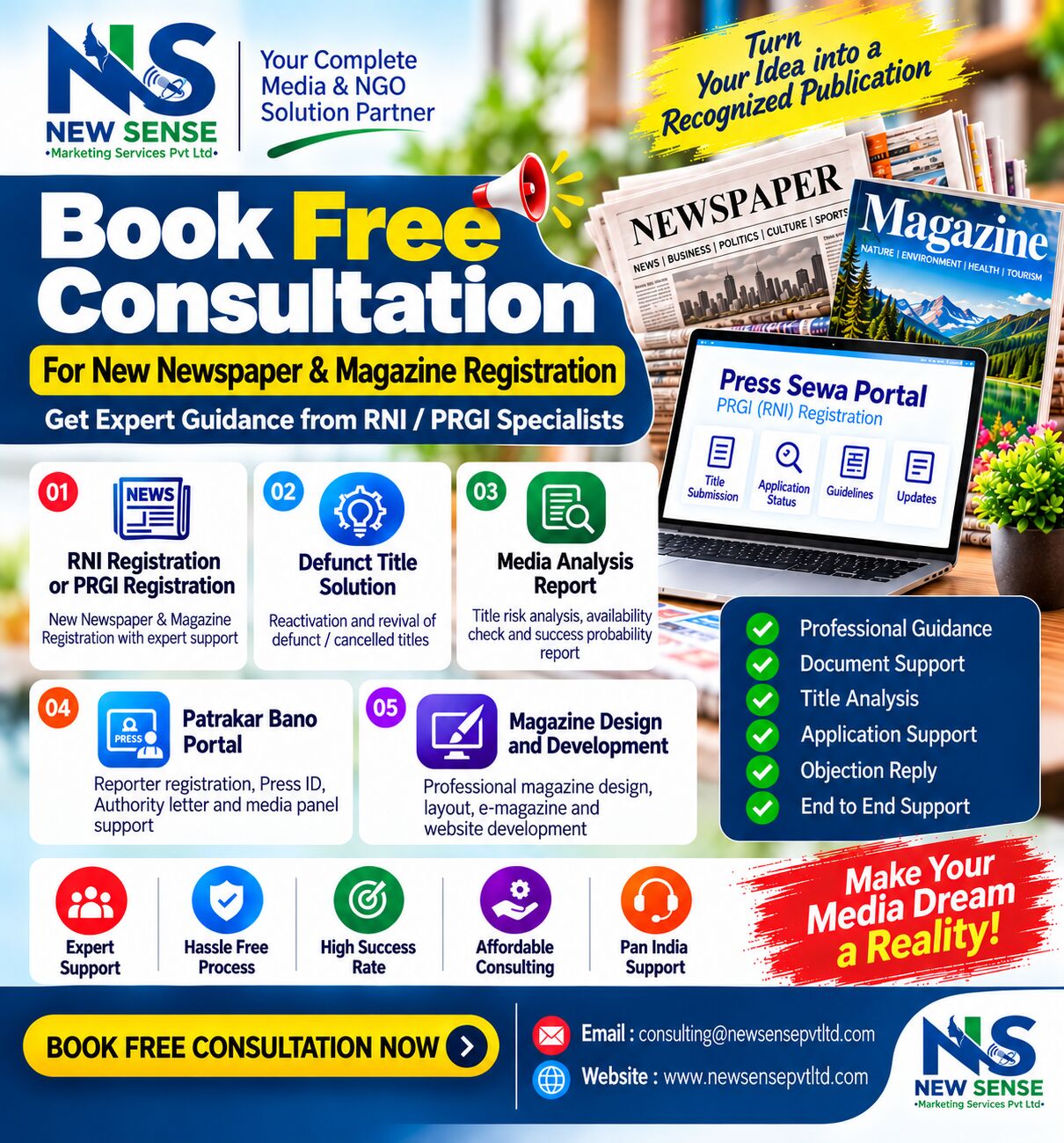
New Sense Marketing Services Pvt. Ltd. provides consulting and application-support services for individuals and organisations interested in entering the publishing and media sector.
Prospective publishers can contact the company to enquire about the following areas of assistance, subject to the services and packages currently available.
Newspaper Registration Assistance
Consulting support for understanding the applicable registration framework, organising publication-related particulars and preparing for the official newspaper registration procedure.
Magazine Registration Guidance
Support for aspiring magazine owners who need assistance in understanding relevant eligibility considerations, application information and procedural requirements.
Preliminary Newspaper Title Review
Guidance in examining proposed newspaper and periodical names against relevant title-related criteria and identifying potential issues before an application is submitted.
Such preliminary assistance is not an official title-allotment decision. Final approval remains with PRGI.
Press Sewa Portal Application Support
Applicants who need help understanding the online process can enquire about assistance with portal formalities, application information and the organisation of supporting documents.
Assistance with Application Objections and Queries
Where an application receives an official communication, publishers can seek assistance in understanding the matter and preparing a fact-based response in accordance with the applicable procedure.
The authority concerned retains full discretion over the acceptance or rejection of any response.
Annual Statement and Compliance Consulting
Registered publishers can enquire about guidance concerning applicable annual statements, changes in publication information and other relevant post-registration responsibilities.
Media Website Development and Magazine Design
A professional digital presence can complement a newspaper or magazine’s print identity. Depending on the selected service, publishers can also enquire about website development, magazine layout, digital editions and publication design.
Professional assistance can make the preparation process more organised and help applicants identify avoidable administrative errors. However, private consulting is separate from the official registration authority’s functions.
New Sense Marketing Services Pvt. Ltd. does not guarantee registration approval, title allotment, government accreditation, readership, advertising arrangements or business profitability.
11. Common Publishing and Registration Mistakes to Avoid
Newspaper and magazine owners can reduce unnecessary complications by paying attention to both administrative preparation and editorial management. The following mistakes deserve particular attention.
Proceeding Without Examining the Proposed Title
A publication name should be reviewed against the relevant PRGI criteria and existing records before the application proceeds. Ignoring potential title conflicts may create avoidable complications.
Submitting Contradictory or Incorrect Particulars
Information concerning ownership, publisher details, addresses, printing arrangements and other declarations should be checked for consistency. Inaccurate entries or mismatched supporting records can lead to application queries.
Following Outdated Registration Instructions
Older online articles may describe procedures that no longer apply. Publishers should use the latest instructions available through the official PRGI website and Press Sewa Portal.
Treating Registration as a Guarantee of Business Income
Registration is an administrative requirement, not a promise of commercial success. Develop a practical plan covering audience development, operating costs, distribution and revenue generation.
Using Sensationalism as a Substitute for Editorial Quality
The Yellow Press approach may focus on immediate attention, but a publication should build its identity through informative reporting, compelling presentation and evidence-based stories.
Releasing Information Without Adequate Examination
Unconfirmed statements, misleading photographs and incomplete reports can undermine the credibility of a media organisation. Create an editorial review system that gives priority to verification.
Overlooking Continuing Responsibilities
Registration is not necessarily the final compliance step. Publishers should monitor relevant notifications, retain application records and understand the continuing obligations that apply to their particular publication.
12. Frequently Asked Questions About Yellow Press and PRGI Registration
1. What is Yellow Press?
Yellow Press describes a style of journalism that relies on sensational headlines, exaggerated presentation or misleading information to attract public attention, sometimes at the expense of accuracy and fairness.
2. Is Yellow Press the same as Yellow Journalism?
The expressions are closely related and are commonly used to describe sensational reporting that prioritises attention over responsible journalism.
3. Is Yellow Press legal in India?
The expression describes a style of reporting rather than a separate legal offence. However, specific conduct involving defamation, unlawful disclosure, fabricated claims or other violations may attract legal consequences depending on the circumstances.
4. What is the difference between Yellow Press and responsible journalism?
Yellow Press is associated with sensational or misleading presentation, whereas responsible journalism prioritises verification, fairness, context, accuracy and accountability.
5. What is RNI Registration?
RNI Registration is a widely recognised search term for newspaper registration in India. The relevant authority is now the Press Registrar General of India (PRGI).
6. What is PRGI Registration?
PRGI Registration refers to obtaining the applicable Certificate of Registration for an eligible periodical under the Press and Registration of Periodicals Act, 2023.
7. How can I register a newspaper in India?
Eligible applicants must follow the prescribed online process through the official Press Sewa Portal, provide the required information and documents, and complete the applicable formalities.
8. Can I register a magazine through PRGI?
A magazine containing public news or comments on public news may fall within the applicable definition of a periodical. Eligibility depends on its nature and the statutory framework.
9. Does PRGI registration guarantee government accreditation?
No. Registration and government accreditation are separate matters involving different requirements and procedures.
10. Can a consultant guarantee newspaper registration approval?
No private consultant can guarantee approval. The final decision rests with PRGI and the competent authorities.
11. Can sensational headlines attract newspaper readers?
Interesting headlines can attract readers when they accurately reflect the underlying report. Unsupported claims and misleading presentation can damage a publication’s credibility.
12. Where can I check the official registration process?
Visit the official Press Registrar General of India website at https://prgi.gov.in/ or access the Press Sewa Portal at https://presssewa.prgi.gov.in/.
Conclusion: Build a Credible Media Business Beyond Yellow Press
The Yellow Press remains an important subject in discussions about media ethics, newspaper publishing and the responsibilities of modern journalism. Sensational presentation may attract immediate attention, but credibility, accuracy and public trust are essential for developing a sustainable publication.
For aspiring publishers in India, the right approach is to combine engaging content with responsible editorial practices and proper administrative preparation. Understanding PRGI Registration, checking the proposed publication title, organising ownership and publishing information, and following the applicable procedures are important steps towards establishing a newspaper or magazine.
New Sense Marketing Services Pvt. Ltd. can be approached for newspaper and magazine registration consulting, title-verification guidance, Press Sewa Portal application support, compliance guidance, website development and magazine design services.
Build your publication with a clear identity, professional planning and a commitment to responsible journalism.
Choose credibility over sensationalism. Build a publication that readers can trust.
Contact New Sense Marketing Services Pvt Ltd
- Website: https://newsensepvtltd.com/
- Contact / WhatsApp: 94112 29553
- Email : consulting@newsensepvtltd.com
- Our Magazine: https://prakritidarshan.com/
- Our Newspaper: https://prakritidarshannews.com/
- Our International Journal (ISSN): https://prakritidarshanjournal.com/index.php/pdijemds/index
Important: Publishers should independently verify the latest requirements, application procedures, applicable fees and relevant provisions through the official PRGI/Press Sewa system before proceeding. Government rules and procedures may be revised from time to time.
Disclaimer
This article is intended for general informational and promotional purposes only and does not constitute legal advice. Registration requirements and procedures may change. Verify current information through official PRGI sources. New Sense Marketing Services Pvt. Ltd. is a private consulting service provider, not a government authority, and does not guarantee registration approval, accreditation, readership or commercial success.
Yellow Press, Yellow Press in India, Yellow Press in Digital Age. Yellow Press Meaning, Yellow Press Definition Yellow Press and Yellow Journalism, Yellow Press Effects.
What Is Yellow Press in Journalism, Yellow Press Meaning and Definition, History and Origin of Yellow Press, Yellow Press vs Responsible Journalism, How Yellow Press Influences Public Opinion, Yellow Press and Sensational News Reporting, Impact of Yellow Press on Society, Yellow Press Examples in Modern Media, Yellow Press Ethics and Media Responsibility, How to Identify and Avoid Yellow Press Journalism
Yellow Press in Modern Journalism, Yellow Press and Media Credibility, Yellow Press Business Model, Yellow Press Techniques and Strategies, Role of Yellow Press in Digital Media, Yellow Press and Fake News, Yellow Press Headlines and Clickbait Culture, Yellow Press Impact on Democracy, Yellow Press and Freedom of the Press, Future of Yellow Press in India