





News Website Ownership vs. White-Label Publishing: A Practical Guide for Media Entrepreneurs
Every successful media company starts with a great story. But to actually get that story in front of readers, scale your audience, and generate revenue, you need the right technology.
You might start your media venture with a small editorial team and a few local stories, only to find yourself managing a multi-city publication a few years later. As your audience grows, the tech stack supporting your operation becomes just as critical as your editorial calendar.
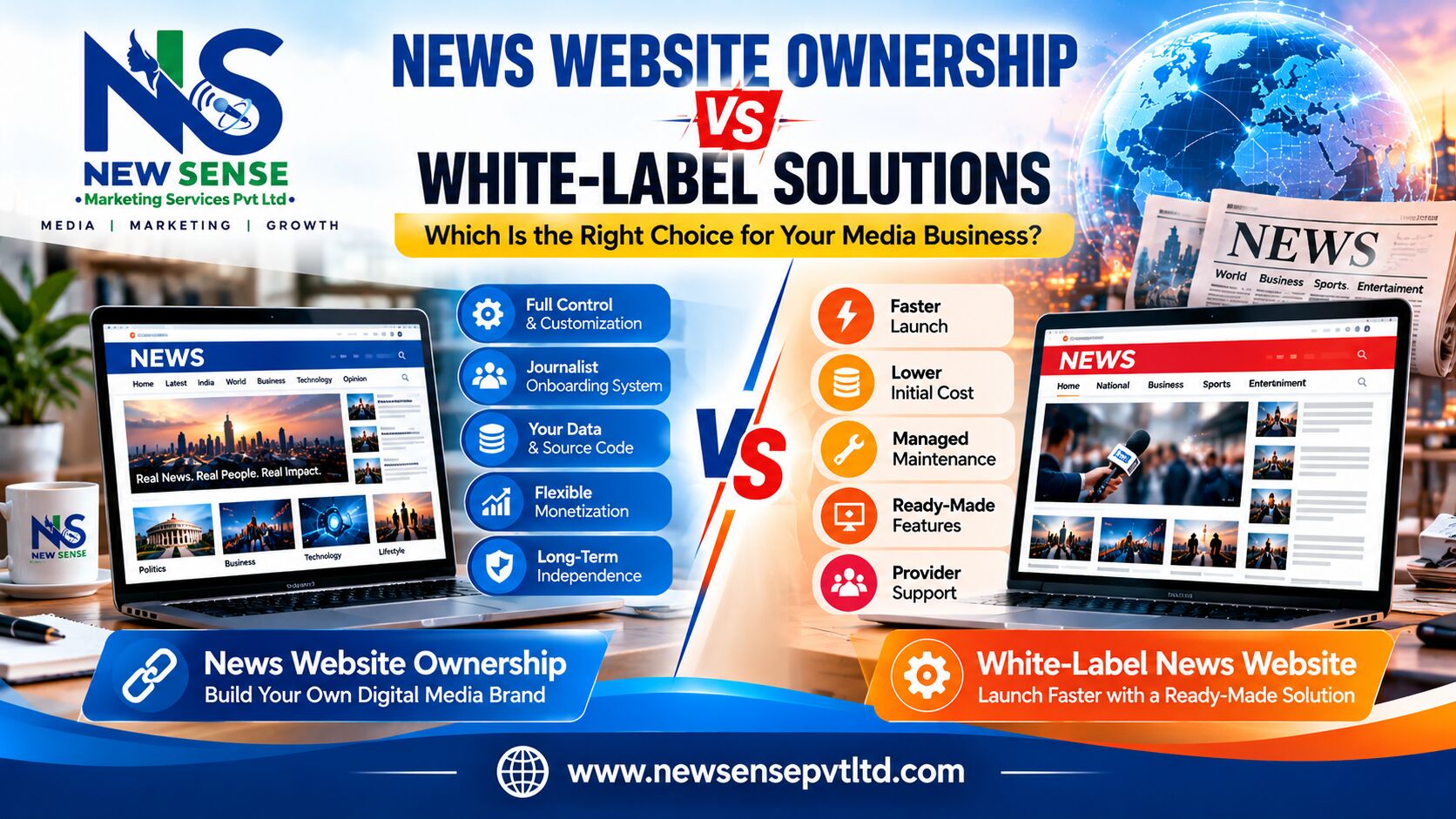
This brings you to a major crossroads: do you invest in full news website ownership to build a custom engine, or do you launch quickly using a white-label news website?
This decision goes far beyond how your homepage looks. It dictates how your reporters file stories, how your editors manage workflows, how you roll out paywalls, and how easily you can pivot your tech strategy down the road. Let’s break down exactly what each path looks like in the real world.
1. The Two Paths to Building Your Digital News Business
Path A: Building a Custom Platform (Ownership)
When you pursue true news website ownership, you start by mapping out your exact operational needs rather than forcing your workflow into a pre-made box.
Imagine a regional paper that needs distinct dashboards for field reporters, district correspondents, and senior editors. Reporters might need a mobile-first interface to file quick updates, while editors need a robust backend to review, edit, and schedule pieces. Later, you might want to bolt on a subscription paywall or a programmatic ad manager.
This route allows your news portal development to be tailored specifically to your business model. However, the level of control you actually get depends heavily on your development contract, software licenses, and whether the underlying code is truly handed over to you.
Path B: Starting with a White-Label System
A white-label news website is essentially a ready-made digital news platform built by a third party. You slap your logo on it, configure the settings, and start publishing.
This is a lifesaver for entrepreneurs who want to test a local news concept without spending months on custom news portal development. If the base system already handles articles, categories, media uploads, and basic admin tasks, your team can focus entirely on journalism.
The catch? You are bound by the provider’s technical limits and commercial terms. You can only build within the sandbox they provide.
Neither approach is inherently “better.” The right choice depends on whether your biggest hurdle is launching quickly or building a highly specific, long-term media machine.
2. What Do You Actually Control?
The biggest mistake media entrepreneurs make is assuming that having their logo on the homepage means they own the site. An admin login doesn’t automatically mean you can export your database, migrate your servers, or tweak the source code.
Before you sign any contract, evaluate your control across these five pillars:
- Brand Control: You own your domain, logo, and visual identity. (Both models usually offer this).
- Operational Control: How user permissions, article submissions, and editorial workflows are managed.
- Technical Control: Access to the source code, server hosting, third-party integrations, and backend configuration.
- Data Control: Your ability to export articles, images, user data, and create independent backups.
- Commercial Control: Your freedom to set subscription prices, manage ad networks, and build direct business partnerships.
A solid news website ownership agreement will explicitly state which of these rights belong to you. A white-label provider might give you total brand control but keep the technical and data control locked behind their paywall. That’s fine, as long as you know the limits going in.
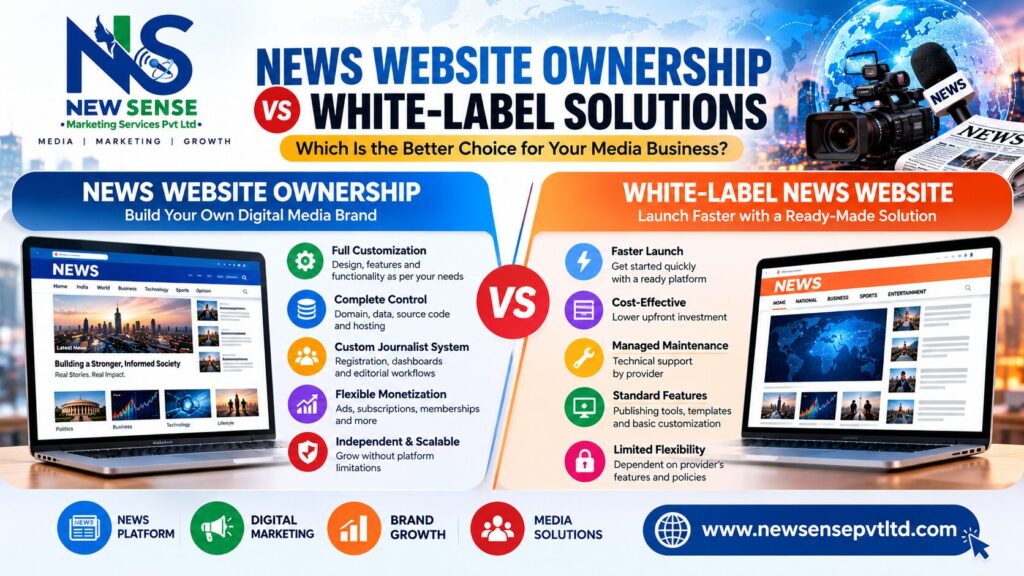
3. Detailed Comparison: Ownership vs. White-Label
| Decision Factor | Independent Ownership (Custom Build) | White-Label Platform |
| Development Approach | Engineered around your specific workflows. | Built around the provider’s existing features. |
| Visual Identity | Limitless customization for news website design. | Configurable, but restricted to their templates. |
| Domain Administration | Registered and controlled directly by you. | Must be explicitly confirmed in the service agreement. |
| Source Code Access | Can be negotiated and transferred to you. | Almost always restricted or unavailable. |
| Content Portability | Planned from day one; you own the database. | Depends entirely on the provider’s export tools. |
| Journalist Accounts | Custom roles, permissions, and dashboards. | Limited to the features included in your tier. |
| Editorial Workflow | Tailored to your exact approval processes. | Restricted to the provider’s supported workflows. |
| Payment Integration | Choose any gateway for subs/ads. | Limited to the provider’s pre-approved integrations. |
| Launch Timeline | Slower; depends on scope, testing, and QA. | Much faster; ready to deploy out of the box. |
| Initial Budget | Higher upfront news website cost. | Lower initial setup or onboarding fees. |
| Ongoing Support | You manage it internally or hire contractors. | Usually included in your monthly service fee. |
| Feature Expansion | Limited only by your dev budget and architecture. | Limited by the provider’s product roadmap. |
| Provider Independence | High, as long as your data and code are portable. | Low; you are tied to their migration policies. |
How to read this: The ultimate advantage of news website ownership is aligning your tech perfectly with your business model. The downside is the heavy lifting of managing developers and maintenance. White-label reduces the technical headache but introduces strict ceilings on customization.
4. Ranking the Options by Business Priorities
Instead of giving a generic “score,” here is how each model ranks when you have specific business goals in mind:
- Building specialized publishing features: Ownership. You need a custom journalist onboarding system or unique paywall logic.
- Launching a basic publication quickly: White-label. You just need to get articles online and start building an audience.
- Developing a massive contributor network: Ownership. You need highly specific roles and editorial workflows for hundreds of freelancers.
- Minimizing initial technical work: White-label. You don’t have an in-house tech team and want managed support.
- Planning independent infrastructure: Ownership. You want total control over hosting, security, and data portability.
- Outsourcing routine technical operations: White-label. You want someone else to handle server updates and bug fixes.
- Creating a highly differentiated media product: Ownership. Your unique UX and custom features are your main competitive advantage.
- Testing an unproven publishing concept: White-label. You want to validate the market with minimal financial risk.
5. Real-World Scenarios: Which Model Fits?
Scenario A: The Local Network Needs a Contributor Network
You are launching a regional portal covering five different districts. You need local stringers to register online, submit drafts, upload photos from their phones, and track their submission status. Your editors need a specific workflow to request edits before publishing.
- The Verdict: News website ownership wins here. A custom journalist onboarding system and tailored editorial dashboard are critical to managing this operation smoothly. A white-label tool might work, but only if it already has this exact workflow built-in.
Scenario B: The Lean Startup Testing the Waters
You are an entrepreneur launching a niche city-focused news site. You have a small team, a tight budget, and you just need to prove that people will read your content.
- The Verdict: Go with a white-label news website. You don’t need to reinvent the wheel. Focus your limited capital on hiring good writers and marketing, rather than sinking money into custom news portal development.
Scenario C: The Revenue Diversifier
Your publication is growing. You now want to offer free articles, premium paid tiers, sponsored content, newsletter sponsorships, and event ticketing.
- The Verdict: This requires complex user permissions, multiple payment gateways, and deep analytics. News website ownership gives you the flexibility to stitch these revenue streams together, provided you have the budget for the initial news website cost and ongoing maintenance.
6. The Real Budget: Short-Term Costs vs. Long-Term Value
The sticker price for building a site is rarely the actual cost of running it. When evaluating the news website cost, you need to look at the Total Cost of Ownership (TCO) over 36 months.
| Expense Category | Ownership Approach | White-Label Approach |
| Initial Launch | High (Design, custom dev, QA) | Low/Medium (Setup, onboarding, training) |
| Hosting | Separate monthly/annual bill | Usually bundled into the service fee |
| Maintenance | Internal staff or retained agency | Included in the provider’s SLA |
| New Features | Pay for dev hours to build and test | Pay for platform upgrades or custom add-ons |
| Security & Backups | You arrange and monitor this | Provider manages this (verify in contract) |
| Migration/Exit | Low (if you own the code/data) | Potentially high (if data export is restricted) |
The 3-Year Forecast Rule: Before committing to news website ownership, add up: initial dev, 36 months of hosting, security, maintenance, new feature builds, tech support, and potential exit costs.
A cheap white-label package might look great on day one, but if you have to pay for five different “premium add-ons” to get the features you need by year two, it gets expensive fast. Conversely, a custom build is a waste of money if you only ever use basic article publishing. Forecast your actual needs.
7. Who Should Choose What? Recommendations by Publisher Type
- Independent Journalists: Keep it simple. Use a white-label platform or a standard CMS. Don’t pay for custom features until you have a proven revenue stream to justify them.
- Local/Regional Newspapers: You need mobile filing, strict editorial permissions, and location-based routing. If your workflow is highly specific, lean toward news website ownership.
- Magazine Publishers: Focus on beautiful news website design, deep archives, and multimedia. A high-end white-label system or a heavily themed CMS is usually plenty.
- Media Entrepreneurs: If your core strategy relies on a massive freelance network, complex memberships, or multi-brand publishing, invest in a custom build to ensure the tech scales with your vision.
- Agencies Managing Multiple Brands: White-label is king here. You need standardized deployments and centralized support to manage multiple clients efficiently.
- Established Digital Media Companies: Tech is your moat. Prioritize data portability, server performance, and security. News website ownership is non-negotiable when your platform is your main competitive advantage.
8. The Due Diligence Checklist: Questions to Ask Before Signing
Don’t rely on sales pitches. Get these answers in writing before you sign a development contract or a white-label SaaS agreement.
- Domain: Will the domain be registered directly in my company’s legal name?
- Source Code: If I build custom, do I own the IP and the source code outright?
- Database: Can I run a full, clean export of my articles, media, and user data at any time?
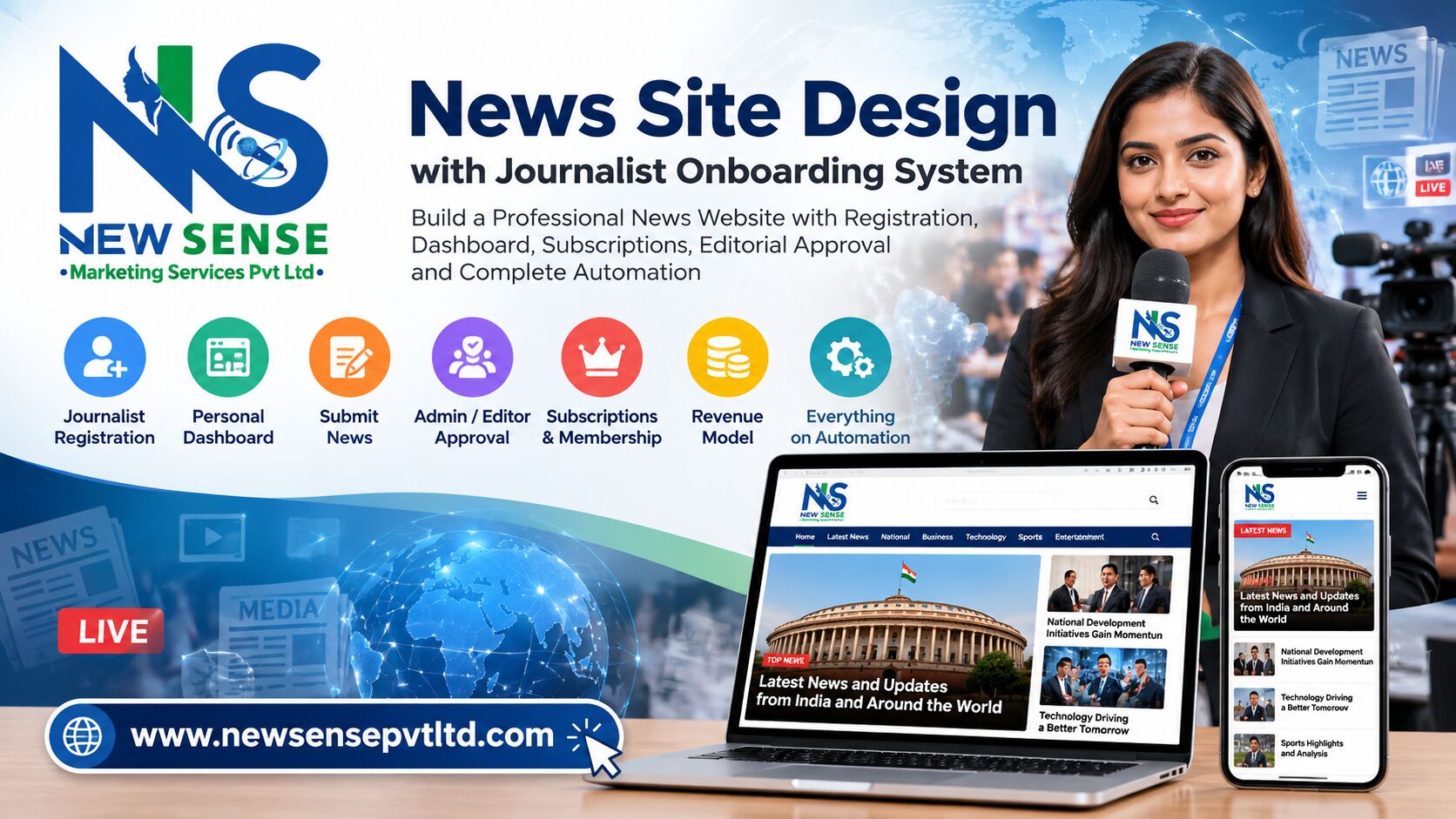
- Journalists: Does the platform support a true journalist onboarding system (registration, drafting, profile management)?
- Editorial Controls: Can I create custom roles (e.g., “Freelancer,” “Section Editor,” “Publisher”) with specific permissions?
- Branding: How deep does the news website design customization go? Can I edit the core CSS/HTML?
- SEO: Do I have full control over URL structures, metadata, schema markup, and sitemaps?
- Security: Who is legally and technically responsible for patching vulnerabilities and managing backups?
- Payments: Can I plug in my own Stripe/PayPal accounts, or am I forced to use the provider’s payment routing?
- Support: What is the exact SLA for support? What counts as a “billable extra”?
- Exit Strategy: If I cancel the service tomorrow, how do I get my data out, and in what format?
9. The Final Verdict
The best publishing model is the one that removes friction from your editorial team without creating a technical or financial trap for your business.
News website ownership is the right move if your business model relies on unique workflows, a massive contributor network, or proprietary tech features. It demands strong project management and a realistic maintenance budget, but it gives you total independence.
A white-label news website is the smart play if you need to validate an idea quickly, rely on standard publishing features, and offload technical headaches to a managed team. Just ensure the contract allows you to export your data if you ever need to leave.
Final Recommendation: If your editorial operations and future revenue streams are highly specialized, prioritize a well-documented ownership arrangement. If you just need to get a great publication online and start building an audience tomorrow, start with a white-label platform. Compare the actual deliverables, protect your budget, and build a clear path for your future growth.
10. Frequently Asked Questions
1. What exactly does news website ownership mean? It means you have legal, documented control over the core assets of your publication—specifically the domain, the source code, the database, and the hosting environment. The exact scope depends on your development contract.
2. Is owning a news website always better than using a white-label platform? Not always. Ownership is better when you need deep customization and data independence. White-label is better when you need to launch fast, keep initial costs low, and rely on managed technical support.
3. How much does news portal development actually cost? It varies wildly based on your news website design complexity, custom features, and integrations. Always ask for an itemized quote and calculate the 3-year total cost, including hosting and maintenance, not just the initial build fee.
4. Can I get the source code from my developer? Yes, but it must be explicitly negotiated in your contract. Ensure the agreement states that you own the custom code, and check how third-party plugins or libraries are licensed.
5. Can freelance journalists publish directly through the portal? Yes, if you use a platform with a robust journalist onboarding system. You can set up workflows where freelancers submit drafts that require editor approval before going live.
6. Which model is better for SEO? Both can be highly optimized. The real factors are site speed, mobile responsiveness, clean URL structures, and content quality. Custom ownership gives you total control over technical SEO configurations, but a good white-label platform will handle the basics perfectly.
7. How does a news website actually make money? Common streams include display advertising, sponsored content, digital subscriptions, paywalls, and newsletter sponsorships. Your tech stack needs to support the specific monetization tools you plan to use.
8. Can I migrate away from a white-label provider later? It depends entirely on your contract. If the provider doesn’t offer clean data exports or if your content is locked in a proprietary database format, migrating can be a nightmare. Always check the exit clauses before signing.
9. Who handles website security and backups? In a custom build, you (or your dev team) are responsible. In a white-label setup, the provider usually handles it, but you must verify their backup frequency and security protocols in the SLA.
10. What should a first-time media entrepreneur choose? Start with your core needs and your budget. A white-label solution is usually best to validate your concept and start publishing. Once you prove your model and need custom features, you can invest in news website ownership.
Disclaimer
This article is intended for general information and educational purposes. It does not constitute legal, financial, tax, or professional advice. NGO registration, trust registration, magazine registration, tax exemptions, CSR implementing agency eligibility, and animal welfare permissions depend on applicable laws, rules, documentation, and individual circumstances.
Readers should verify current requirements through the relevant government authorities and seek qualified professional advice where necessary. CSR grants, government grants, tax benefits, registration approvals, publication acceptance, and revenue are not guaranteed.
References to consulting services are informational and do not constitute a guarantee of results. Readers should confirm the current scope of services, fees, timelines, and terms directly with the service provider before engaging any consultant.
Contact New Sense Marketing Services Pvt Ltd
- Website: https://newsensepvtltd.com/
- Contact / WhatsApp: 94112 29553
- Email : consulting@newsensepvtltd.com
- Our Magazine: https://prakritidarshan.com/
- Our Newspaper: https://prakritidarshannews.com/
- Our International Journal (ISSN): https://prakritidarshanjournal.com/index.php/pdijemds/index



News Website Ownership vs. White-Label Solutions, News Website Ownership vs. White-Label Publishing, News Website Ownership vs. White-Label Solutions News Website, News Website Ownership vs. White-Label Solutions Newspaper Website, News Website Ownership vs. White-Label Solutions News Portal, News Website Ownership vs. White-Label Solutions for Newspaers, News Website Ownership vs. White-Label Solutions for Magazines, News Website Ownership vs. White-Label Solutions for Publishers.
News Website Ownership vs. White-Label Solutions which is Better, News Website Ownership vs. White-Label Solutions Which is Long-Term Soluton, News Website Ownership vs. White-Label Solutions 16-Point Never Ignore, News Website Ownership vs. White-Label Solutions Best Guide, News Website Ownership vs. White-Label Solutions Comparision, News Website Ownership vs. White-Label Solutions Comparision is Important before Start. News Website Ownership vs. White-Label Solutions Real Woth.