








Defunct Newspaper Reactivation: The newspaper industry in India continues to offer opportunities for entrepreneurs, journalists, publishers, media professionals, and business owners who want to establish or revive a presence in print and digital media. However, running a newspaper requires more than publishing news. Publishers must understand registration requirements, maintain records, comply with applicable regulations, and complete the necessary formalities within the prescribed time.
One important issue faced by newspaper owners is the status of a defunct or cancelled newspaper title. A newspaper may become inactive because of financial difficulties, a change in ownership, a lack of publishing resources, administrative problems, or failure to complete mandatory compliance requirements. In some cases, the publisher may wish to restart publication but discover that the title is marked as defunct or cancelled in the official records.
This is where Defunct Newspaper Reactivation becomes an important area of professional consulting.
Defunct Newspaper Reactivation involves reviewing the newspaper’s registration history, identifying its current regulatory status, examining the reasons for inactivity or cancellation, and determining the appropriate procedure for restoration or fresh registration, as applicable. The correct procedure depends on the title’s status and the requirements communicated by the competent authority.
New Sense Marketing Services Pvt Ltd provides RNI and PRGI consulting services to help newspaper owners and publishers understand their cases, prepare documentation, address regulatory deficiencies, and navigate the applicable procedures.
This article explains the meaning of a defunct newspaper, the difference between defunct and cancelled titles, the possible reactivation process, common challenges, and how professional RNI consulting services can support publishers in India.
Table of Contents
- What Is Defunct Newspaper Reactivation?
- What Does Defunct Newspaper Status Mean?
- Difference Between Defunct and Cancelled Newspaper Titles
- Why Do Newspapers Become Defunct?
- Importance of Defunct Newspaper Reactivation
- PRGI Rules and the Regulatory Framework
- Step-by-Step Defunct Newspaper Reactivation Process
- Documents Required for Reactivation
- Common Challenges and Mistakes to Avoid
- How New Sense Marketing Services Pvt Ltd Can Help
- Benefits of Professional RNI Consulting Services
- Frequently Asked Questions
- Conclusion and Disclaimer
1. What Is Defunct Newspaper Reactivation?
Defunct Newspaper Reactivation refers to the process of determining whether a newspaper title whose publication has stopped or whose official status has changed can lawfully resume publication under the applicable regulatory procedure.
In India, newspaper registration and related administration are governed by the applicable legislation and rules. The Press Registrar General of India (PRGI) administers the registration framework for periodicals under the current system, while older records may refer to the Registrar of Newspapers for India (RNI).
The term reactivation is commonly used by publishers and consultants to describe efforts to restore a newspaper’s ability to publish. However, it does not necessarily mean that every defunct or cancelled title can simply be switched back to active status.
Before taking action, a publisher should establish:
- Whether the title is marked as defunct, cancelled, suspended, or otherwise inactive.
- Whether an official order or communication has been issued.
- Whether a restoration or revival window or procedure is available.
- Whether outstanding annual returns or other compliance matters need attention.
- Whether the existing registration can be restored or a fresh application is required.
A proper preliminary assessment helps the publisher select the correct route instead of spending time and money on an unsuitable application.
2. What Does Defunct Newspaper Status Mean?
A defunct newspaper generally refers to a registered newspaper that has stopped publishing or has been identified as inactive under the applicable administrative process.
The circumstances can vary. A publication may have stopped because its owner relocated, printing costs increased, the editorial team changed, advertising revenue declined, or the publisher failed to maintain regular operations.
Sometimes, a publisher assumes that the title remains active because an old registration certificate is available. However, historical registration documents alone may not establish the title’s current regulatory status.
Publishers should therefore verify the official record and review relevant notices, orders, portal entries, and correspondence before attempting to resume publication.
A title that has become defunct may require a different procedure from a title whose registration has formally been cancelled. Understanding this distinction is the foundation of an effective reactivation strategy.
3. Difference Between Defunct and Cancelled Newspaper Titles
Defunct and cancelled are not necessarily interchangeable terms. Their precise implications depend on the official record and the applicable legal provisions.
| Basis of comparison | Defunct newspaper | Cancelled newspaper |
| General meaning | Publication has stopped or the title is recorded as inactive | Registration or title status has been formally cancelled |
| Possible reason | Non-publication, inactivity, or compliance issues | Regulatory action or another legally recognised ground |
| First action | Verify the recorded status and relevant requirements | Obtain and examine the cancellation order or official record |
| Possible next step | Determine whether restoration or another procedure is available | Determine whether review, revival, restoration, or fresh registration is legally available |
| Guarantee of revival | Not guaranteed | Not guaranteed |
| Need for official verification | Essential | Essential |
The table provides a general explanation rather than a determination of any particular title’s legal status.
Important: A publisher should not assume that a cancelled title can be revived merely by submitting an application or paying a fee. The available remedy must be confirmed from the current rules, official notices, and the competent authority’s instructions.
4. Why Do Newspapers Become Defunct?
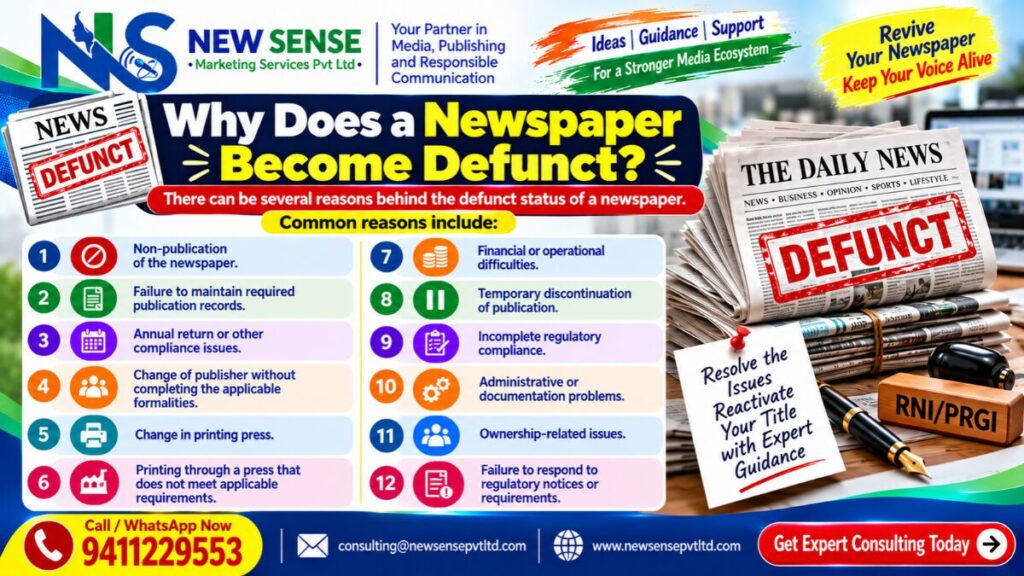
Several operational and administrative circumstances can contribute to a newspaper becoming inactive.
4.1 Failure to Publish Regularly
Newspaper publishing requires a reliable editorial calendar, printing arrangements, distribution planning, and financial resources. When these arrangements break down, regular publication may stop.
4.2 Non-Submission of Annual Returns
Applicable annual return requirements should be monitored carefully. Missing a filing deadline may result in compliance issues and can complicate later efforts to restore publication.
Publishers should verify the relevant financial year, filing deadline, portal status, and any outstanding requirements instead of relying on old schedules.
4.3 Financial Difficulties
Printing expenses, staff payments, transportation, news gathering, and distribution can put pressure on smaller newspapers. Some publishers temporarily discontinue operations and later decide to restart.
4.4 Change in Ownership or Management
A newspaper may face administrative problems when its ownership, publisher, editor, or business arrangements change without the necessary formalities being completed.
4.5 Incomplete Documentation
Missing registration records, inconsistent addresses, outdated contact details, or incomplete supporting documents can make it difficult to establish the newspaper’s current position.
4.6 Lack of Knowledge About PRGI Procedures
The registration framework and portal procedures may change over time. Publishers who rely exclusively on outdated information may miss important compliance requirements or follow an incorrect procedure.
Understanding the reason for inactivity is essential because the appropriate solution depends on the individual case.
5. Importance of Defunct Newspaper Reactivation
A newspaper title may represent years of professional effort, local recognition, editorial identity, and relationships with readers and advertisers. For this reason, owners often explore lawful options to resume publication rather than abandon the title.
Defunct Newspaper Reactivation can be important for several reasons.
Preserving an established identity: A publisher may wish to continue using the same newspaper title, subject to official approval and the title’s current legal status.
Restoring publishing operations: Reactivation planning can help the publisher rebuild an editorial team, arrange printing, and prepare a sustainable publication schedule.
Improving compliance: Reviewing the title’s history may reveal pending returns, unanswered notices, or other issues that should be addressed before further action.
Supporting business continuity: A newspaper can be part of a larger media business that includes advertising, local reporting, digital content, and community engagement.
Avoiding unnecessary applications: A proper status assessment may help determine whether an existing title can be restored or whether another application route is required.
Reactivation should always be pursued through the applicable official procedure. It should not be treated as an automatic entitlement or a guaranteed result of consultancy.
6. PRGI Rules and the Regulatory Framework
The Press Registrar General of India is the relevant authority under India’s current periodical registration framework. The Press and Registration of Periodicals Act, 2023, and the applicable rules provide the legal framework for registration and related matters.
Older newspapers may have documents issued under the earlier RNI system. Their records may therefore contain historical terminology, certificates, correspondence, and references to earlier procedures.
When a publisher seeks Defunct Newspaper Reactivation, the appropriate first step is to establish which rules, records, and procedures apply to the particular title.
Publishers should consult the official PRGI portal:
Official portal: https://presssewa.prgi.gov.in/
The portal and official communications should be used to verify current requirements, available services, notices, and the title’s recorded status.
Depending on the case, a publisher may need to review previous registration details, outstanding compliance, official communications, or instructions concerning cancelled and defunct titles.
Professional consultants can help interpret the documentation and prepare a response, but the competent authority retains the power to determine the application’s outcome.
7. Step-by-Step Defunct Newspaper Reactivation Process
There is no single procedure that applies to every defunct or cancelled newspaper. The following steps provide a practical framework for assessing a case.
Step 1: Collect Existing Newspaper Records
Gather the old registration certificate, title particulars, publication details, ownership records, and available copies of previous correspondence.
The more complete the records, the easier it becomes to establish the title’s history.
Step 2: Verify the Current Status
Check the relevant official records and portal information. Identify whether the newspaper is described as defunct, cancelled, or subject to another status or order.
If the status is unclear, seek clarification through the appropriate official channel.
Step 3: Examine Notices and Orders
Read all available deficiency letters, cancellation orders, notices, and communications carefully.
The reason recorded by the authority can influence the next step. A compliance-related issue may require a different response from a formal cancellation or a title-related restriction.
Step 4: Identify the Applicable Procedure
Determine whether the current rules provide a restoration, revival, review, or other applicable route. If restoration is unavailable, assess whether a fresh registration application is legally permissible.
Do not assume that an old title can be reused without checking the official position.
Step 5: Prepare Supporting Documents
Prepare accurate documents and ensure that names, addresses, title particulars, and other details are consistent wherever required.
Any discrepancy should be examined and corrected through the appropriate procedure rather than concealed.
Step 6: Address Outstanding Compliance
Where applicable, review annual returns, publication records, and other pending obligations. Complete the required steps in accordance with the instructions and timelines communicated by the authority.
Step 7: Submit the Applicable Application or Representation
Submit the relevant application, representation, or response through the prescribed channel, following the current instructions.
Keep acknowledgement numbers and copies of submitted documents for future reference.
Step 8: Respond to Further Queries
If the authority requests additional information or issues a deficiency communication, prepare a factual response supported by the relevant documents.
Step 9: Follow the Official Decision
Monitor the application and follow any directions issued by the authority. Resume publication only after satisfying the applicable requirements and confirming the title’s lawful status.
8. Documents Required for Defunct Newspaper Reactivation
The documents needed depend on the title’s history, the reason for its inactivity, and the procedure available in the particular case.
| Document or information | Purpose |
| Previous registration certificate or record | Establishes historical registration details |
| Newspaper title and publication particulars | Identifies the publication concerned |
| Owner and publisher details | Helps verify the relevant parties |
| Previous official notices or orders | Explains the recorded status and reasons for action |
| Annual return or compliance records, where applicable | Helps assess outstanding obligations |
| Publication copies or supporting evidence, where required | Supports the publication history |
| Address and contact details | Helps verify current particulars |
| Supporting affidavits or declarations, if required | Addresses specific documentary requirements |
| Application acknowledgement or portal records | Helps track previous submissions |
This is an indicative list, not a universal checklist. Do not submit every document indiscriminately. Confirm the exact requirements for the title and the applicable procedure before filing.
9. Common Challenges and Mistakes to Avoid
Defunct Newspaper Reactivation can become complicated when the publisher acts without first understanding the official record.
Assuming That Every Defunct Title Can Be Restored
A title’s status, cancellation history, and applicable rules determine the available options. Some cases may require a different application route.
Ignoring the Reason for Cancellation
Submitting an application without addressing the grounds stated in an official order can lead to further objections or rejection.
Relying on Outdated Information
Older RNI procedures and current PRGI processes should not be treated as identical in every respect. Verify current instructions before acting.
Providing Inconsistent Details
Differences in names, addresses, ownership particulars, or publication information may create avoidable questions.
Ignoring Annual Return Obligations
Outstanding compliance should be reviewed wherever relevant. Publishers should not assume that filing a missing return automatically restores a defunct or cancelled title.
Trusting Guaranteed Reactivation Claims
No private consultant can guarantee an official decision. Be cautious of claims promising automatic approval, fixed processing times, or certain restoration without reviewing the case.
Failing to Keep Records
Always preserve copies of applications, supporting documents, official responses, and acknowledgement receipts.
A structured approach reduces avoidable errors and helps publishers understand the next appropriate step.
10. How New Sense Marketing Services Pvt Ltd Can Help With Top RNI Consulting Services
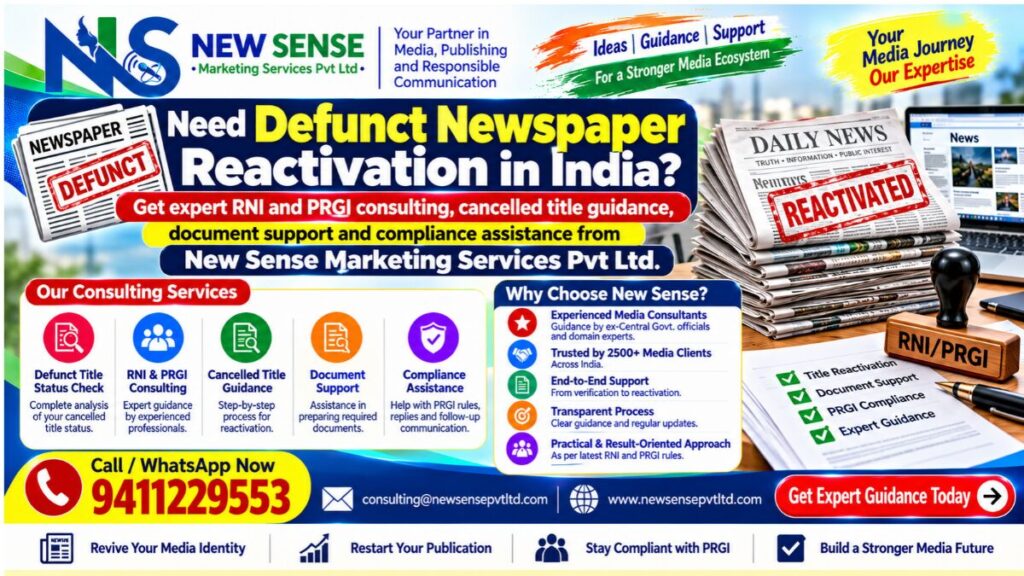
New Sense Marketing Services Pvt Ltd provides consulting support for newspaper and magazine owners who need assistance with RNI and PRGI registration matters. For a defunct newspaper, the company’s role can begin with a review of the available records and continue through document preparation and procedural guidance, according to the scope of the engagement.
The company offers support in the following areas.
10.1 Preliminary Title Status Assessment
The first task is to review the available registration documents, title particulars, official communications, and known compliance history.
This helps identify the questions that must be resolved before selecting a reactivation or fresh application route.
10.2 Defunct Newspaper Reactivation Consultation
The company can help the publisher understand the nature of the recorded status, identify potential procedural options, and prepare a checklist of information required for further action.
The final procedure must be verified against current official requirements.
10.3 Cancelled Title Review and Revival Guidance
Where a title has been formally cancelled, the available order and relevant correspondence should be examined. Consulting support may include organising the records, identifying issues requiring clarification, and preparing an appropriate representation where legally permissible.
Whether a title can be revived depends on the competent authority and applicable rules.
10.4 Drafting Replies to Deficiency Communications
If the publisher receives a deficiency letter or requests for clarification, New Sense Marketing Services Pvt Ltd can assist in drafting a structured reply based on the facts and supporting documents supplied by the client.
A well-organised response should address each point raised by the authority without introducing unsupported statements.
10.5 Annual Return and Compliance Guidance
The company can help publishers review applicable annual return requirements, organise records, understand filing procedures, and identify outstanding compliance issues.
The specific obligations and deadlines should be verified for the relevant period.
10.6 Ownership Transfer and Particulars Update Guidance
When ownership or other publication particulars have changed, the publisher may need to complete additional formalities. The company can help identify the applicable requirements and prepare supporting documentation.
10.7 Fresh Registration Consultation
If the existing title cannot be restored through the applicable procedure, the publisher may need to explore fresh registration, where legally permissible. The company can provide guidance on the relevant process and help prepare the required information.
10.8 End-to-End Procedural Support
Depending on the agreed service scope, assistance may cover document checklists, application preparation, representations, responses to deficiencies, and follow-up guidance.
Why consider New Sense Marketing Services Pvt Ltd?
- Consulting focused on newspaper and magazine registration.
- Assistance with historical RNI records and current PRGI-related matters.
- Structured document preparation and deficiency-response support.
- Guidance on title status, compliance, and possible procedural options.
- Support for publishers seeking to resume or develop their media businesses.
Before engaging a consultant, request a clear description of the services, applicable fees, expected deliverables, and any additional official charges. The company provides consulting support; the final decision on restoration, revival, or registration remains with the competent authority.
11. Benefits of Professional RNI Consulting Services
Professional consulting can be useful when a publisher is unfamiliar with the applicable procedure or has incomplete historical records.
Better understanding of the case: A structured review helps separate administrative problems from issues requiring a formal legal or regulatory remedy.
Improved document organisation: A checklist can reduce missing information and inconsistencies.
Clearer official representations: A well-drafted reply can address the authority’s questions point by point.
Time management: Identifying the applicable route early can reduce avoidable rework.
Compliance awareness: Publishers can better understand the records and obligations they need to maintain if publication resumes.
Consulting services cannot replace an official decision, guarantee approval, or remove the need to meet legal requirements. Their value lies in helping the publisher prepare accurately and proceed through the appropriate channels.
12. Frequently Asked Questions About Defunct Newspaper Reactivation
Q1. What is Defunct Newspaper Reactivation?
Defunct Newspaper Reactivation refers to assessing and pursuing the applicable official procedure for resuming publication of a newspaper whose status is recorded as defunct or inactive.
Q2. Can a defunct newspaper be reactivated in India?
Possibly, depending on the title’s status, the applicable rules, and the options permitted by the competent authority. Reactivation is not automatic.
Q3. Is a defunct newspaper the same as a cancelled newspaper?
No. Defunct generally describes an inactive publication, while cancelled may indicate a formal regulatory action. The official record must be checked to establish the precise status.
Q4. Which authority handles newspaper registration in India?
The Press Registrar General of India (PRGI) administers the current registration framework for periodicals under the applicable legislation and rules.
Q5. What is the official PRGI website?
The official portal is https://presssewa.prgi.gov.in/. Publishers should check it for current procedures and official communications.
Q6. What documents are required for Defunct Newspaper Reactivation?
Requirements vary. They may include the previous registration record, title details, ownership particulars, official notices, compliance records, and other supporting documents requested for the particular case.
Q7. Can I reactivate my newspaper using an old RNI certificate?
An old certificate can help establish historical details, but it does not by itself prove that the title is currently eligible for publication. Verify the current official status first.
Q8. What if my newspaper registration has been cancelled?
Obtain and examine the cancellation order. The available remedy depends on the reasons for cancellation, applicable rules, and any current restoration or review procedure.
Q9. Is a fresh registration application always necessary?
No. The appropriate route depends on the title’s status and the current rules. A fresh application should not be assumed necessary or permissible without checking the case.
Q10. Can a newspaper title be reused after cancellation?
Not automatically. The title’s current status and eligibility must be verified through the official process before any reuse is attempted.
Q11. Can outstanding annual returns affect my case?
Outstanding returns or other compliance issues may complicate the case, depending on the applicable requirements. Review the relevant period and follow official instructions.
Q12. How long does Defunct Newspaper Reactivation take?
There is no universal processing time. The duration may depend on the case, completeness of documentation, applicable procedure, and the authority’s response.
Q13. Can a consultant guarantee reactivation?
No responsible consultant should guarantee an official outcome. A consultant can provide procedural guidance and document-preparation support, but approval rests with the competent authority.
Q14. How can New Sense Marketing Services Pvt Ltd help?
The company can assist with preliminary status assessment, document checklists, drafting deficiency replies, compliance guidance, cancelled-title review, and other agreed RNI or PRGI consulting services.
Q15. Does New Sense Marketing Services Pvt Ltd provide fresh RNI or PRGI registration consulting?
The company offers newspaper and magazine registration consulting. The applicable service and procedure should be confirmed according to the client’s title, circumstances, and current registration framework.
Q16. Can the company draft a reply to a PRGI deficiency letter?
Yes, consulting support may include drafting a reply based on the official communication and documents provided by the client. The response should be factually accurate and address the specific deficiencies raised.
Q17. What information should I provide for an initial consultation?
Provide the newspaper’s title, language, publication details, old registration record if available, current status, and copies of relevant official notices or orders. Avoid sending unnecessary sensitive information until it is requested through an appropriate channel.
Q18. How can I contact New Sense Marketing Services Pvt Ltd?
You can contact the company through its official website, https://newsensepvtltd.com/, or share your enquiry through the company’s verified contact channels. Ask specifically for Defunct Newspaper Reactivation or RNI/PRGI consulting services.
13. Contact Details of New Sense Marketing Services Pvt Ltd
For consultation regarding Defunct Newspaper Reactivation, cancelled newspaper titles, RNI registration, PRGI procedures, annual return compliance, and deficiency replies, contact:
New Sense Marketing Services Pvt Ltd
- Website: https://newsensepvtltd.com/
- Service category: RNI and PRGI Registration Consulting
- Key services: Defunct Newspaper Reactivation Consultation, Cancelled Title Review, Fresh Registration Guidance, Deficiency Reply Drafting, Annual Return Compliance Guidance, and Ownership Transfer Consultation.
- Enquiry: Visit the website and use the available official contact details to request a consultation.
- Our Magazine: https://prakritidarshan.com/
- Our Newspaper: https://prakritidarshannews.com/
- Our International Journal (ISSN): https://prakritidarshanjournal.com/index.php/pdijemds/index
Please verify the current telephone number, email address, office address, service availability, and applicable fees directly through the company’s official channels before making payment or submitting original documents.
Conclusion
Defunct Newspaper Reactivation can be an important step for publishers who want to resume their media activities, preserve an established publication identity, and resolve outstanding registration issues. However, success begins with understanding the title’s exact status and identifying the procedure permitted under the current regulatory framework.
A defunct title and a cancelled title may require different approaches. Historical registration certificates, pending annual returns, ownership changes, and previous official orders should all be reviewed before a publisher submits an application or representation.
New Sense Marketing Services Pvt Ltd can support newspaper owners through preliminary case assessment, document preparation, deficiency-response drafting, compliance guidance, and consultation on applicable RNI and PRGI procedures. Its consulting services can help publishers approach the process in a more organised and informed manner.
If your newspaper has become defunct or its registration has been cancelled, begin by collecting the relevant records and checking the official status. Seek professional guidance where necessary, follow the applicable rules, and proceed only through the authorised process.
Disclaimer: This article is intended for general informational and educational purposes. It does not constitute legal advice or an assurance that a particular newspaper title can be restored. Applicable procedures, eligibility, fees, deadlines, and official requirements may change. Verify the current position with PRGI and obtain appropriate professional advice for your specific case. New Sense Marketing Services Pvt Ltd is a consulting service provider and does not control decisions made by government authorities.



Defunct Newspaper Reactivation, Defunct Newspaper Reactivation Revival, PRGI Defunct Newspaper Reactivation, RNI Defunct Newspaper Reactivation, PRGI RNI Defunct Newspaper Reactivation, Defunct Newspaper Reactivation in India, Defunct Newspaper Reactivation Online, Defunct Newspaper Reactivation Consulting, Defunct Newspaper Reactivation Services. New Sense Marketing Services for Defunct Newspaper Reactivation.